Sewage Cleanup and Sanitization in Evanston
Sewage cleanup and sanitization in Evanston, IL. Insurance billing accepted. Call us now.
Our technicians are dispatched from our Chicago, IL headquarters and are typically on-site in Evanston within 60 minutes of your call.
Evanston’s combined sewer system, where storm runoff and sanitary waste share the same underground pipes, means that a heavy Lake Michigan storm can push raw sewage back through floor drains and basement fixtures with very little warning. When that happens, the contamination isn’t just unpleasant; Category 3 “black water” carries bacteria, viruses, and parasites that colonize porous surfaces within hours. Dry Bros Water & Fire Restoration responds to sewage backup calls throughout Evanston, handling extraction, disinfection, and structural drying so the property is safe to occupy again.
Why Evanston Properties See Sewage Backup Problems
Evanston sits on a narrow strip of land between Lake Michigan and the North Shore suburbs, and that geography shapes its drainage challenges in ways that differ from inland Chicago neighborhoods. The city’s older residential blocks, many built between the 1890s and 1940s, were plumbed when combined sewers were standard practice. During significant rainfall events, the volume of stormwater entering the system can exceed its capacity, and the path of least resistance is often back up through the lowest fixture in a basement.
Foundation types compound the problem. Older homes in the blocks west of Ridge Avenue frequently have rubble-stone or brick foundations with clay-tile lateral lines that have cracked or root-infiltrated over decades. A slow lateral failure can go unnoticed until a backup makes it impossible to ignore. Newer construction closer to the lakefront tends to have better-isolated sanitary lines, but even those properties are not immune when the main sewer is overwhelmed.
The city has invested in sewer separation projects in certain corridors, but much of the residential grid still operates on the combined system. Homeowners who have not yet installed an overhead sewer or backwater valve are the most exposed.
Our Sewage Cleanup and Sanitization Process in Evanston
Sewage cleanup is not the same as water damage cleanup. The contamination classification changes everything about how materials are handled and what the finished standard looks like.
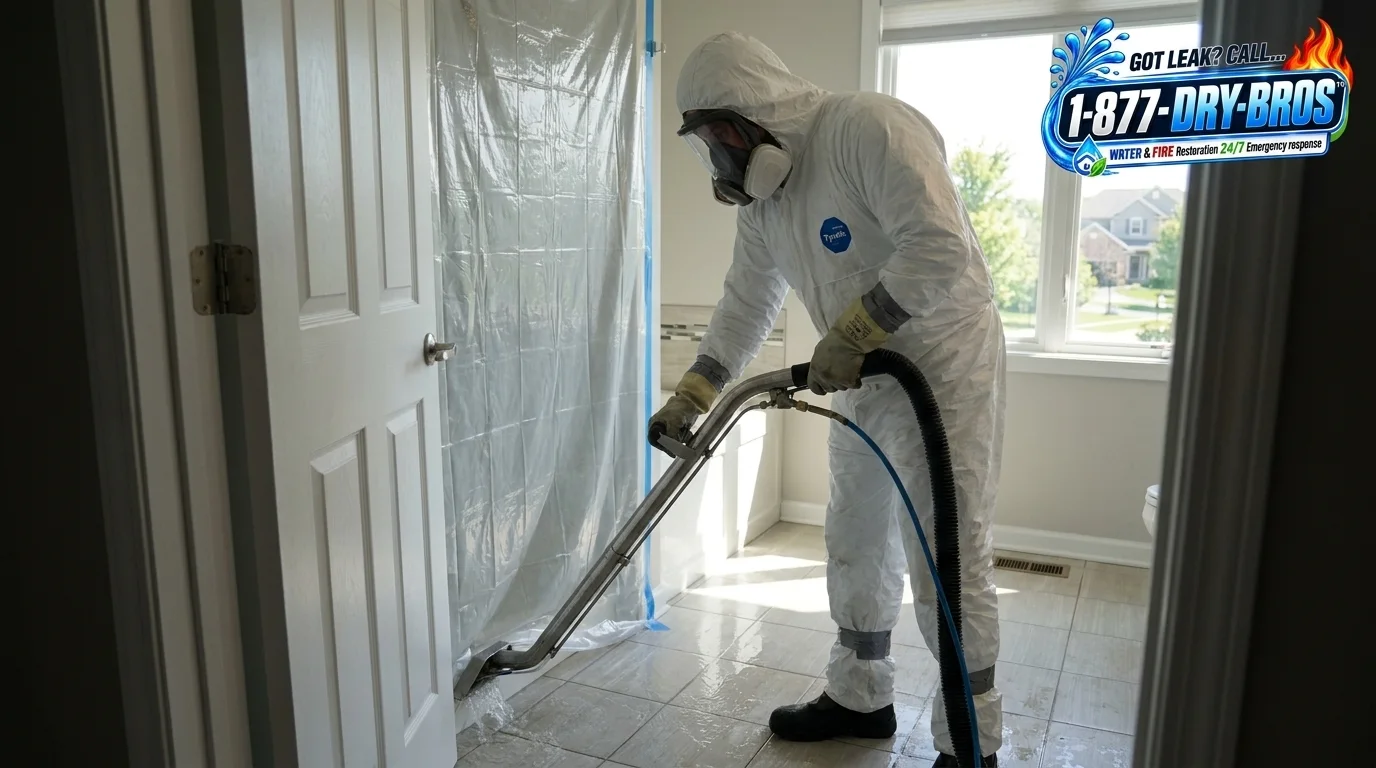
Containment and PPE setup. Before any extraction begins, the affected area is isolated to prevent cross-contamination to living spaces. Technicians work in full personal protective equipment throughout the job.
Solid waste and standing water removal. Visible solids are removed first, followed by extraction of standing contaminated water using truck-mounted or portable units capable of handling debris-laden waste.
Removal of unsalvageable materials. Porous materials, drywall, insulation, carpet, and pad, that have direct sewage contact are removed and bagged for disposal per Illinois EPA guidelines for biohazardous waste. In Evanston’s older homes, this sometimes includes original wood subfloor sections that have absorbed contamination deeply enough that surface cleaning is not sufficient.
EPA-registered disinfection. Hard surfaces, framing, concrete, and remaining structural elements are treated with EPA-registered disinfectants formulated for Category 3 water events. Multiple application passes are standard; a single spray-and-wipe is not adequate for raw sewage contamination.
Structural drying. Once the space is sanitized, desiccant or refrigerant dehumidifiers and air movers are positioned to dry the structural assembly. Moisture readings are logged at each visit until the structure returns to baseline.
Post-remediation verification. Surface samples or ATP testing can be performed before reconstruction begins to confirm the space is clean.
Reaching Evanston from Chicago
Dry Bros operates out of Chicago, and Evanston is a direct run up Sheridan Road or the Edens Spur depending on traffic and the specific address. The northern neighborhoods near the Wilmette border are just as reachable as the blocks closer to downtown Evanston, the city is compact enough that no part of it is a difficult dispatch. When you call, give the cross streets and describe what you’re seeing; that lets the crew stage the right equipment before they arrive rather than making a second trip.
Evanston Insurance Coordination
Sewage backup coverage is often a separate endorsement on a standard homeowner’s policy, it is not automatically included, and many Evanston homeowners discover that gap at the worst possible moment. Dry Bros documents the loss thoroughly: photographs of affected materials before removal, moisture readings, waste extraction logs, and an itemized scope of work. That documentation package is what carriers need to process a claim, and having it organized from the start reduces the back-and-forth that delays settlements.
If your policy does not include sewage backup coverage, the documentation still matters, it supports any negotiation with your carrier and establishes a clear record if the backup is traceable to a municipal sewer failure, which opens a separate claims path through the city.
Local Note
Evanston’s older homes, particularly the two- and three-flat buildings common in the blocks east of Chicago Avenue, often have finished basement units with below-grade bathrooms. When a sewer backup occurs in one of those units, the contamination footprint is frequently larger than it appears on first inspection because the sewage has traveled under the finished floor before surfacing. Pulling up a small section of tile or laminate at the perimeter often reveals that the contamination extends several feet beyond the visible wet area. Scoping the extent before writing a cleanup plan saves time and prevents incomplete remediation.
If you’re dealing with sewage backup in Evanston, call Dry Bros at call us now. The sooner extraction begins, the less structural material ends up in the dumpster, and the shorter the path back to a clean, usable space.
Sewage Cleanup and Sanitization in Evanston: Service Coverage
Frequently Asked Questions
How fast can you arrive for sewage cleanup and sanitization in Evanston?
Does Evanston's combined sewer system make sewage backups more likely than in other North Shore communities?
Are the older two- and three-flat buildings near Chicago Avenue in Evanston harder to remediate after a sewage backup?
How does Illinois EPA guidance affect how sewage-contaminated materials are disposed of in Evanston?
What does the sanitization step actually involve, and how do I know the space is clean when it's done?
My Evanston homeowner's policy didn't cover the backup, does documentation still matter if I'm paying out of pocket?
Will my homeowners insurance cover sewage cleanup and sanitization in Evanston?
Sewage Cleanup and Sanitization response in Evanston
Most Evanston calls see a technician on-site within 60 minutes from our Chicago headquarters.