Smoke Damage Restoration in Chicago
Smoke damage restoration in Chicago and surrounding areas. Insurance billing accepted. Call us now.
Smoke doesn’t stop moving when the fire goes out. Within hours of extinguishment, smoke residue penetrates wall cavities, settles into HVAC ductwork, and bonds to surfaces throughout rooms that never saw a single flame. The odor you notice on day one is a fraction of what’s embedded in the structure. Without the right chemistry, equipment, and sequencing, that smell comes back, sometimes weeks later, and the discoloration you thought was cleaned reappears on ceilings and woodwork. Smoke damage restoration is not cleaning. It’s a structured decontamination process.
What smoke damage restoration actually involves
Smoke is a mixture of partially combusted particles, gases, and volatile organic compounds. What it leaves behind depends entirely on what burned. A kitchen grease fire produces a wet, sticky protein soot that’s nearly invisible on surfaces but generates an intense odor and smears badly if wiped incorrectly. A house fire involving synthetic materials, flooring, furniture foam, plastics, wiring insulation, produces a dry, alkaline soot that spreads aggressively and is caustic enough to etch glass and corrode metal within 72 hours. Older Chicago homes with plaster walls, original woodwork, and cast-iron radiators present additional challenges: plaster is highly porous, and smoke migrates deep into it before the surface even looks discolored.
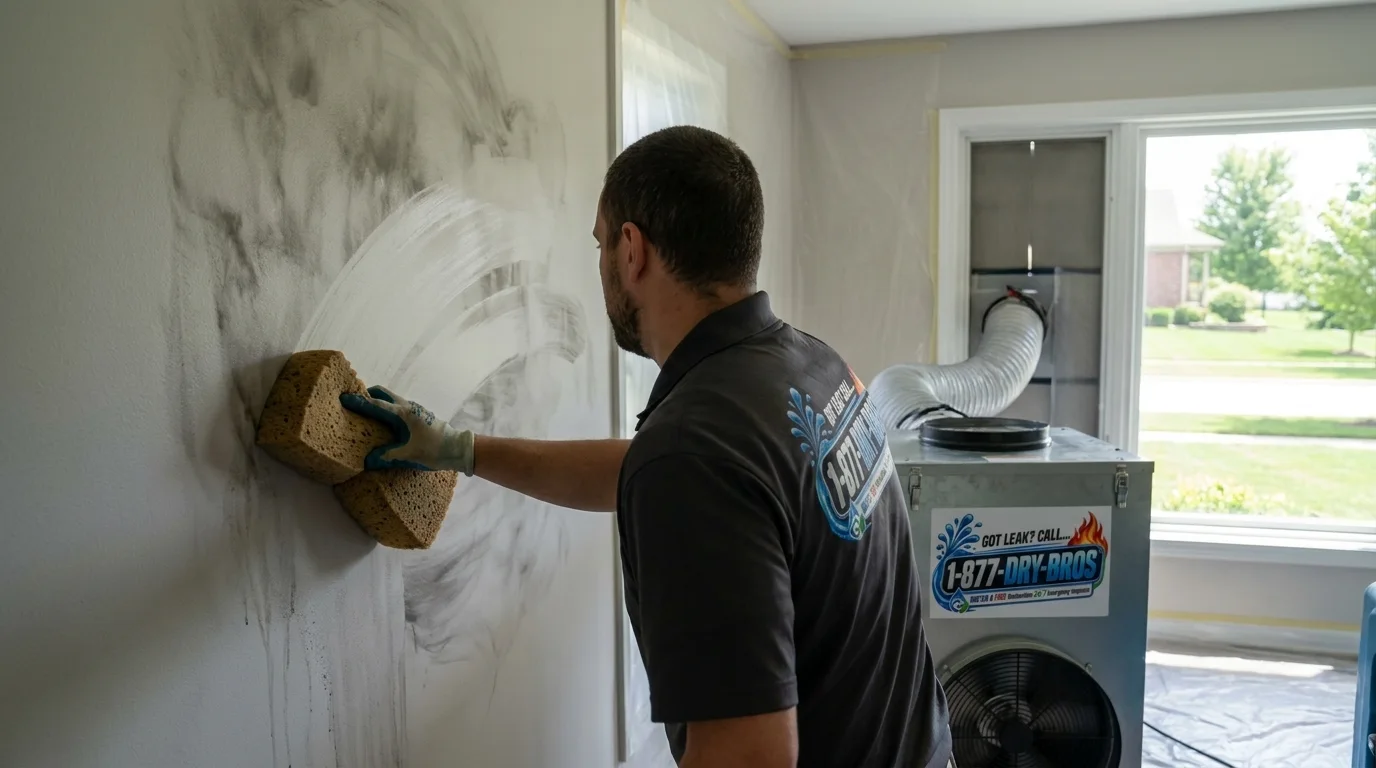
Effective smoke residue cleanup requires matching the chemistry to the soot type. Alkaline dry-sponge wiping for wet protein soot makes it worse. Wet cleaning agents on dry soot can set the stain. Restoration technicians characterize the soot first, then select the appropriate cleaning agents, agitation method, and odor-counteractant technology. Equipment typically includes HEPA air scrubbers, thermal foggers, hydroxyl generators, and ozone chambers for contents, each serving a distinct purpose in the decontamination sequence.
Our process
-
Soot characterization and scope documentation. Before any cleaning begins, every affected surface is assessed and documented, type of soot, degree of penetration, affected square footage, and contents at risk. This documentation drives both the restoration plan and the insurance claim.
-
Containment and HVAC isolation. Smoke residue travels through air handler systems during and after a fire. Ductwork is sealed off before cleaning begins to prevent cross-contamination, and air scrubbers are positioned to create negative pressure in heavily affected zones.
-
Structural surface cleaning. Walls, ceilings, cabinetry, and structural materials are cleaned in the correct sequence, top to bottom, using chemistry matched to the soot type. Porous materials like unsealed wood and plaster may require multiple cleaning passes or, in severe losses, controlled removal.
-
Thermal fogging and odor neutralization. A thermal fogger disperses a deodorizing solution in a particle size that mimics smoke behavior, allowing it to reach the same cavities and porous surfaces the smoke penetrated. This step is not optional on any loss with significant odor, surface cleaning alone cannot reach embedded smoke compounds.
-
Contents and HVAC restoration. Soft contents (clothing, upholstery, bedding) are inventoried and either cleaned on-site or packed out for specialized treatment. Ductwork is inspected and cleaned to prevent smoke odor from recirculating when the system is restored.
What separates a good smoke damage response from a bad one
The most common failure in post-fire smoke cleanup is treating it as a cleaning job rather than a restoration job. A crew that wipes surfaces, applies a coat of primer, and declares the work done has almost certainly left smoke compounds in wall cavities, subflooring, and ductwork. Homeowners often don’t know this until they return to an occupied space and the odor returns with humidity or heat.
A second common gap is soot misidentification. Applying the wrong cleaning chemistry doesn’t just fail to remove the soot, it can permanently set it into the substrate, turning a restorable surface into one that requires replacement. On Chicago’s older housing stock, where original plaster, hardwood floors, and built-in millwork have real preservation value, this mistake is costly.
Insurance adjusters reviewing smoke damage claims look for line-item documentation of affected materials, soot type notation, and evidence that cleaning agents and methods were appropriate to the loss. A restoration scope that lacks this detail is harder to supplement if hidden damage is discovered later.
What does smoke damage restoration cost?
Typical costs depend heavily on the size of the affected area, the type of soot involved, and how far smoke migrated through the structure. Most homeowners pay somewhere in the range shown below, these are industry-typical figures, not Dry Bros quotes, and every loss is different. Dry Bros Water & Fire Restoration provides a written scope of work before any restoration begins so there are no surprises mid-project.
Homeowners insurance generally covers smoke damage restoration when the loss results from a sudden, accidental fire, including kitchen fires, electrical fires, and structure fires on adjacent properties. Smoke damage from a fireplace used over many years is typically excluded as a maintenance issue.
| Scenario | Typical industry range |
|---|---|
| Single room, light smoke and soot | $1,500 – $4,000 |
| Single room, heavy synthetic soot | $3,500 – $8,000 |
| Whole-home smoke migration, no structural damage | $8,000 – $20,000 |
| Whole-home with ductwork cleaning and contents pack-out | $15,000 – $40,000 |
| Severe loss with partial structural involvement | $30,000 – $75,000+ |
Seasonal and regional considerations
Chicago’s climate creates specific conditions that affect smoke damage outcomes. In winter, homes are sealed tightly against cold, which concentrates smoke compounds indoors and slows natural off-gassing. Thermal fogging in cold conditions requires adjusted dwell times. In summer, high humidity accelerates the bonding of protein soot to surfaces and can reactivate odor in materials that appeared stabilized. Year-round, Chicago’s older housing stock, much of it built before 1960 with balloon-frame construction, allows smoke to travel vertically through wall cavities faster and farther than platform-frame homes, often affecting floors above the fire that show no visible soot at all.
Service area
Dry Bros Water & Fire Restoration serves Chicago and the surrounding region, including communities throughout Cook, DuPage, Lake, and Will counties. Dedicated service-area pages cover specific cities, if you don’t see your community listed, call and ask.
If your home still smells like smoke, the job isn’t finished. Call Dry Bros Water & Fire Restoration at call us now to begin a proper smoke and soot assessment, and get a written scope before any work starts.
Frequently Asked Questions
Does homeowners insurance cover smoke damage restoration?
What's the difference between protein soot and synthetic soot, and why does it change how cleanup works?
Why does smoke odor come back after a room has already been cleaned and repainted?
How far can smoke travel from the room where the fire occurred?
What should I do, and not do, while waiting for the restoration crew to arrive?
Looking for the best smoke damage restoration company in Chicago?
Dry Bros Water & Fire Restoration provides smoke damage restoration in Chicago, IL and the surrounding area. We answer calls 24/7 — call (877) 379-2767 for immediate help.
Need Smoke Damage Restoration now?
We respond 24/7 across Chicago and surrounding IL cities.
Related Coverage
- Our Restoration Services
- Contact Dry Bros Water & Fire Restoration
- Smoke Damage Restoration in Berwyn
- Smoke Damage Restoration in Cicero
- Smoke Damage Restoration in Des Plaines
- Smoke Damage Restoration in Evanston
- Smoke Damage Restoration in Naperville
- Smoke Damage Restoration in Oak Park
- Smoke Damage Restoration in Skokie
- The Fire Damage Restoration Process, Explained