Flood Damage Restoration in Chicago
Flood damage restoration in Chicago and surrounding areas. Insurance billing accepted. Call us now.
Standing water doesn’t wait. Within the first hour after a flood, whether from a backed-up sewer line, a storm surge through a basement window, or a failed sump pump during a heavy Chicago rain, water is already wicking into drywall, saturating subfloor panels, and beginning the chemical process that will turn a manageable cleanup into a structural repair job if it isn’t stopped. Flood damage restoration is the race against that clock: extracting water fast, drying materials to measurable standards, and making sure nothing wet gets sealed behind a wall.
What flood damage restoration actually involves
Flood cleanup is not mopping and running fans. The visible water, the puddle on the basement floor, the soaked carpet, is the easy part. The harder problem is what you can’t see: water that has traveled horizontally through wall cavities, risen through concrete slab by capillary action, or pooled inside insulation bays where no household fan will ever reach it.
Professional flood restoration starts with moisture mapping using thermal imaging cameras and calibrated moisture meters to find the true boundary of the wet zone. That boundary is almost always larger than it looks. From there, the work moves through extraction, structural drying with commercial-grade desiccant or refrigerant dehumidifiers and high-velocity air movers, and continuous monitoring until every affected material reads within normal moisture content ranges, not just dry to the touch.
For flood water that entered from outside or from a sewer backup, the contamination category matters as much as the moisture level. Category 3 water (groundwater, sewage, storm overflow) carries pathogens and requires antimicrobial treatment and, in many cases, removal of porous materials that cannot be adequately sanitized. Category 1 water from a clean supply line is a different scope entirely. Misclassifying the source is one of the most common and costly errors in residential flood cleanup.
Timeline: most residential flood losses require three to five days of active drying, with daily monitoring readings. Larger losses, or those involving Category 3 contamination, run longer.
Our process
-
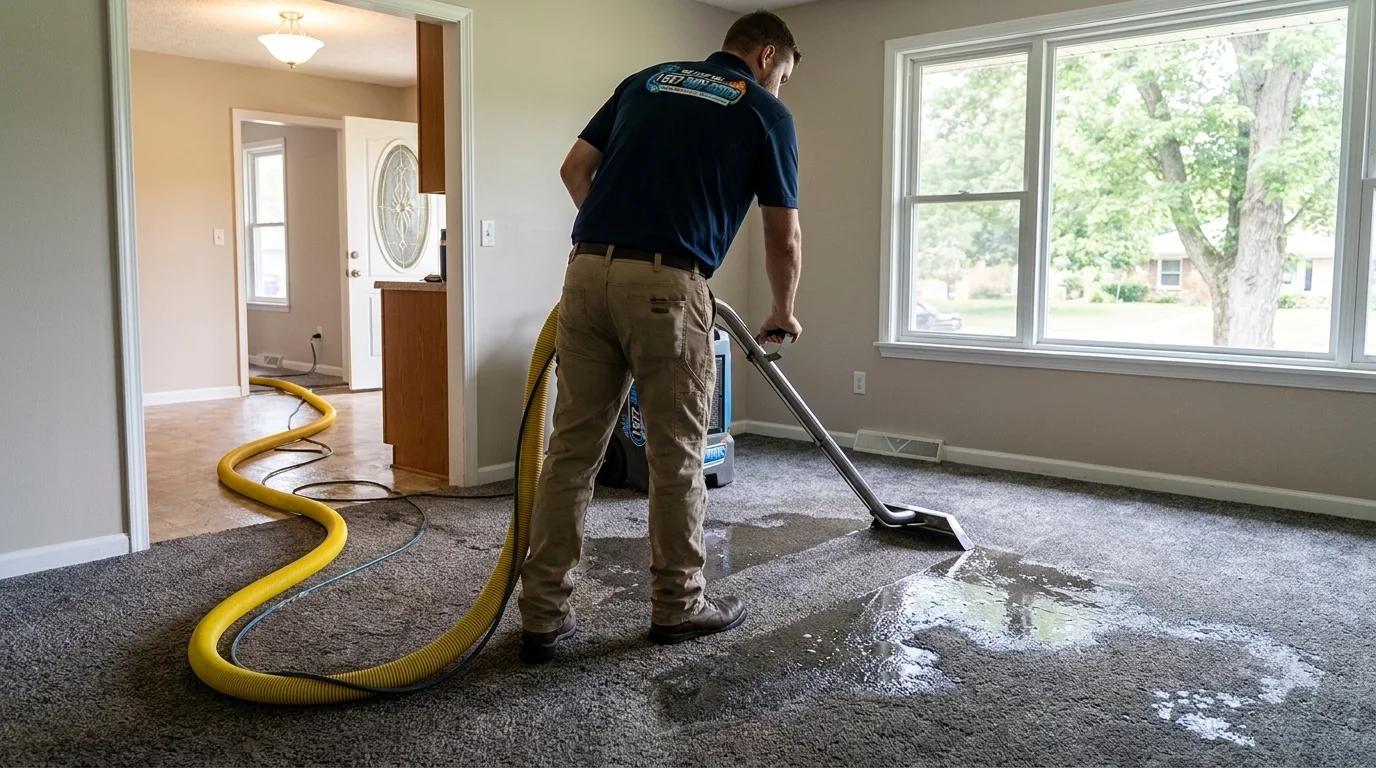
Emergency water extraction. Truck-mounted and portable extractors remove standing water from all affected areas, basement floors, crawl spaces, saturated carpet and pad. Speed here directly limits how far water migrates into structural materials.
-
Moisture mapping and contamination classification. Before any drying equipment is placed, the full wet zone is documented with thermal imaging and moisture meters. The water source is identified and classified (Category 1, 2, or 3) because that determination drives every decision about what gets dried versus what gets removed.
-
Structural drying and dehumidification. Commercial air movers and dehumidifiers are positioned according to the drying plan, not just placed in the middle of the room. For walls and floors, drying mats or injection systems push conditioned air directly into cavities. Daily moisture readings track progress against the drying goal.
-
Contaminated material removal and antimicrobial treatment. Category 2 and 3 losses require controlled demolition of affected drywall, insulation, and flooring to the dry line. Affected surfaces are treated with EPA-registered antimicrobials before enclosure. All removed material is documented for insurance purposes.
-
Final moisture verification and documentation. When all readings confirm materials have reached acceptable moisture content, a final inspection is documented, photos, meter readings, drying logs, and provided to the homeowner and their insurance carrier.
What separates a good flood response from a bad one
The most common failure in residential flood cleanup is declaring a loss dry before it actually is. A surface moisture reading on the face of drywall can show acceptable numbers while the paper backing and the wood framing behind it remain saturated. Mold colonization can begin within 24 to 48 hours in those hidden wet zones, and by the time it’s visible it has already spread.
A second common problem is skipping contamination classification. Flood water that entered a basement during a heavy rain event in Chicago often carries combined sewer overflow, a Category 3 source, not clean groundwater. Treating that loss as a Category 1 cleanup leaves biological contamination behind inside wall assemblies.
What insurance adjusters look for: a complete drying log with daily psychrometric readings, moisture meter readings by material and location, photos of affected areas before and after demolition, and documentation of the water source classification. Losses without this documentation are harder to settle and more likely to generate disputes about what was actually wet.
Dry Bros responds around the clock because the first few hours after a flood are the ones that determine whether a loss stays manageable.
What does flood damage restoration cost?
Typical costs for residential flood damage restoration depend heavily on the size of the affected area, the water category, and how much structural material needs to come out. Most homeowners pay somewhere in the ranges below, these are industry-typical figures, not quotes.
| Scenario | Typical range |
|---|---|
| Single room, Category 1 (clean water) | $1,200 – $3,500 |
| Finished basement, Category 1 | $3,500 – $8,000 |
| Finished basement, Category 2/3 (sewage or storm overflow) | $6,000 – $18,000 |
| Crawl space flood with insulation removal | $2,500 – $7,000 |
| Multi-room loss with structural drying and partial demo | $8,000 – $25,000+ |
Every loss is different, and Dry Bros Water & Fire Restoration provides a written scope of work before any work begins. Standard homeowners insurance typically covers sudden and accidental water losses, burst pipes, appliance failures, and storm-driven water entry through the building envelope, but most policies exclude rising groundwater and surface flooding, which requires a separate NFIP or private flood policy.
Seasonal and regional considerations
Chicago’s combined sewer system serves much of the older residential stock in neighborhoods like Pilsen, Bridgeport, and Logan Square, and it surcharges during heavy rain events, meaning basement backups are a routine seasonal risk, not a freak occurrence. Spring snowmelt combined with rain-saturated ground is the highest-risk window, typically March through May, when the water table is already elevated and sump pumps are running continuously. Homes built before the 1970s are more likely to have clay tile drain tile that has collapsed or offset over decades of freeze-thaw cycling, which reduces drainage capacity exactly when it’s needed most.
Service area
Dry Bros Water & Fire Restoration serves Chicago and the surrounding region, including communities throughout Cook, DuPage, Lake, and Will counties. Dedicated service-area pages cover flood damage restoration in specific cities, find yours through the service area directory or call directly.
If your basement took on water, call call us now now to start the extraction process, the sooner water is out, the smaller the drying scope and the lower the risk of secondary mold damage.
Frequently Asked Questions
Does homeowners insurance cover flood damage restoration?
What is the difference between Category 1, 2, and 3 flood water, and why does it matter for cleanup?
How long does structural drying take after a flood?
What should I do, and not do, while waiting for the restoration crew to arrive?
Why does flood water in Chicago basements so often involve sewage contamination?
Looking for the best flood damage restoration company in Chicago?
Dry Bros Water & Fire Restoration provides flood damage restoration in Chicago, IL and the surrounding area. We answer calls 24/7 — call (877) 379-2767 for immediate help.
Need Flood Damage Restoration now?
We respond 24/7 across Chicago and surrounding IL cities.
Related Coverage
- Our Restoration Services
- Contact Dry Bros Water & Fire Restoration
- Flood Damage Restoration in Berwyn
- Flood Damage Restoration in Cicero
- Flood Damage Restoration in Des Plaines
- Flood Damage Restoration in Evanston
- Flood Damage Restoration in Naperville
- Flood Damage Restoration in Oak Park
- Flood Damage Restoration in Skokie