Board-Up and Tarping in Chicago
Board-up and tarping in Chicago and surrounding areas. Insurance billing accepted. Call us now.
A broken window or a hole in your roof does not wait for business hours. Within hours of a fire, storm, or forced entry, rain gets into exposed framing, looters find an open path, and your insurance claim starts accumulating complications that a piece of plywood or a properly secured tarp could have prevented. Emergency board-up and tarping is the single fastest way to stop a bad situation from becoming a worse one, and the quality of that first response shapes everything that comes after.
What Emergency Board-Up and Tarping actually involves
Board-up and tarping is not hammering scrap wood over a hole. Done correctly, it is a measured process of assessing every breach in a structure’s envelope, windows, doors, roof decking, soffits, garage openings, and sealing each one in a way that holds against weather, deters unauthorized entry, and satisfies the documentation requirements your insurance adjuster will ask for.
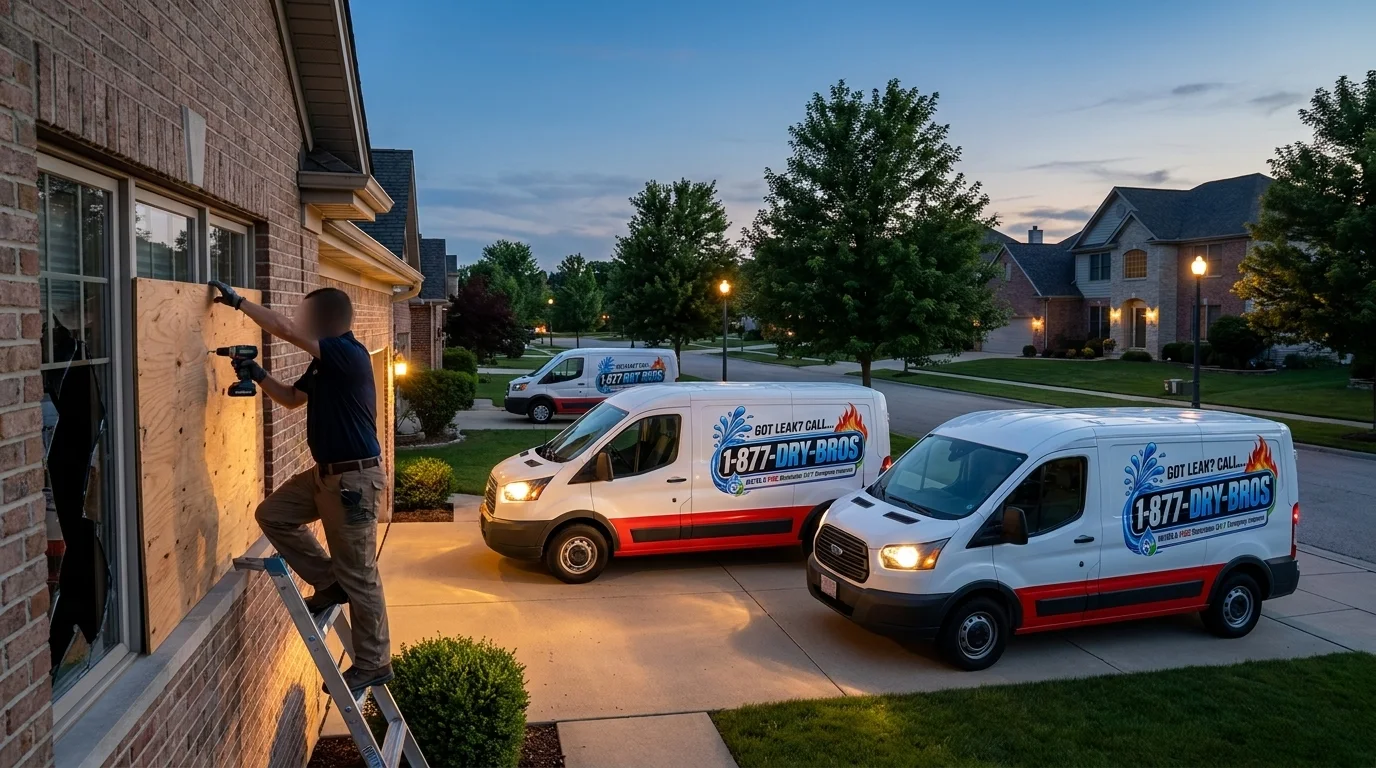
For window and door board-ups, crews typically use ¾-inch plywood cut to fit the rough opening, secured with structural screws into the surrounding framing rather than just the sill or casing. Loose or fire-weakened framing requires additional backing before the panel goes up. Every opening is photographed before and after.
Roof tarping involves more variables. A tarp that is simply laid over damaged sheathing and weighted with sandbags will fail in wind. Proper installation wraps the tarp over the ridge or anchors it to undamaged decking with batten boards screwed into solid substrate, not into charred or saturated wood. The tarp must overlap the damaged area by several feet on all sides and be secured in a way that sheds water rather than pooling it.
In Chicago, where lake-effect storms can arrive with little warning and temperatures can swing 40 degrees in a day, the margin for a poorly installed tarp is thin.
Our process
-
Damage assessment and perimeter walk. Before a single sheet of plywood is cut, a technician walks the full structure, exterior and interior, to identify every compromised opening, note structural hazards, and document existing conditions with photographs. This step protects you if a pre-existing condition becomes a dispute point later in the claim.
-
Material staging and sizing. Plywood is cut on-site to match actual opening dimensions. Tarps are selected by size and mil thickness based on the roof area affected and the forecast. Using undersized or lightweight materials to save time is one of the most common failures in emergency board-up, it looks done, but it doesn’t hold.
-
Securing all openings. Boards are installed with structural fasteners into sound framing. Roof tarps are anchored with batten boards screwed into solid decking, wrapped over the ridge where possible, and sealed at edges to prevent wind lift. Doors that cannot be boarded (fire-damaged frames, commercial roll-ups) are addressed with alternative barricade hardware.
-
Interior protection where needed. If the roof breach has allowed water intrusion, visible wet insulation or ceiling material is noted and photographed for the adjuster. Tarping the roof does not dry the interior, that is a separate scope, but documenting the interior condition at the time of board-up establishes the baseline for any subsequent water damage claim.
-
Completion documentation and handoff. Every opening secured is logged with before/after photos, material dimensions, and fastener placement. This package goes to you and, if you authorize it, directly to your insurance carrier.
What separates a good board-up response from a bad one
The most common failure in emergency board-up is speed prioritized over security. A crew that arrives quickly but uses lightweight tarps, staple guns instead of screws, or panels that don’t reach solid framing has created the appearance of protection without the substance of it. A tarp that fails overnight means a second water intrusion event on top of the original loss, and a more complicated claim.
Insurance adjusters look for a few specific things when they review board-up documentation: photographic evidence of conditions before work began, material specifications (plywood thickness, tarp mil rating), and proof that fasteners reached sound substrate. Gaps in that record can create disputes about what damage occurred before versus after the board-up.
A subtler problem: boarding up a structure that still has active smoldering or compromised load-bearing elements. A proper perimeter walk identifies these conditions before crew members are working overhead or inside.
What does Emergency Board-Up and Tarping cost?
Typical costs for emergency board-up and tarping vary significantly based on the number of openings, roof area affected, structural access, and whether after-hours mobilization is involved. Most homeowners pay somewhere in the ranges below, these are industry-typical figures, not a quote from Dry Bros Water & Fire Restoration.
| Scenario | Typical industry range |
|---|---|
| Single window or door board-up | $150 – $400 |
| Multiple openings (3–6 windows/doors) | $400 – $900 |
| Small roof tarp (up to 200 sq ft) | $500 – $1,200 |
| Large or steep roof tarp (200–800 sq ft) | $1,200 – $3,000 |
| Full structure board-up after fire or storm | $1,500 – $5,000+ |
| After-hours or hazardous-access surcharge | $200 – $600 additional |
Every loss is different, and Dry Bros Water & Fire Restoration provides a written scope before work begins. Homeowners insurance typically covers emergency board-up and tarping as part of a covered peril claim, it falls under the “protect property from further damage” obligation most policies include, though your deductible and policy limits apply.
Seasonal and regional considerations
Chicago’s weather creates specific board-up urgency that milder climates don’t share. A roof breach heading into a nor’easter or a late-season freeze means water intrusion can transition to ice damming within days, compounding structural damage. Summer storm season, particularly the corridor of severe weather that tracks across the Chicago metro from late May through August, produces the highest volume of emergency tarping calls, often with multiple properties affected simultaneously in the same neighborhood.
Older housing stock in neighborhoods like Bridgeport, Pilsen, and the bungalow belt presents its own considerations: balloon-frame construction allows fire and water to travel vertically through wall cavities faster than platform-frame homes, making rapid envelope closure more urgent, not less.
Service area
Dry Bros Water & Fire Restoration serves Chicago and the surrounding metro, including Evanston, Oak Park, Cicero, Berwyn, Skokie, and communities throughout Cook, DuPage, and Lake counties. Individual city pages detail local considerations for each area; all of them connect back to the same crew and the same process described here.
If your structure has an open breach right now, the next step is a call, not a form. Reach Dry Bros at call us now to get a technician moving toward your property and stop the exposure from growing.
Frequently Asked Questions
Does homeowners insurance cover emergency board-up and tarping?
What is the right way to secure a roof tarp so it doesn't fail in wind?
How thick should the plywood be for a fire damage board-up, and does it matter?
What should I do, and not do, while waiting for the board-up crew to arrive?
How do I know if a board-up crew has actually secured every opening, or just the obvious ones?
Looking for the best emergency board-up and tarping company in Chicago?
Dry Bros Water & Fire Restoration provides emergency board-up and tarping in Chicago, IL and the surrounding area. We answer calls 24/7 — call (877) 379-2767 for immediate help.
Need Emergency Board-Up and Tarping now?
We respond 24/7 across Chicago and surrounding IL cities.