Storm Damage Restoration in Cicero
Storm damage restoration in Cicero, IL. Insurance billing accepted. Call us now.
Our technicians are dispatched from our Chicago, IL headquarters and are typically on-site in Cicero within 60 minutes of your call.
Cicero sits in the middle of the Chicago metropolitan weather corridor, where fast-moving storm cells can drop golf-ball hail, spin up brief but violent straight-line winds, and dump two inches of rain in under an hour before the National Weather Service has finished updating its alerts. That combination, sudden intensity, older housing stock, and flat Cook County drainage, means storm damage here rarely looks like a single clean problem. A downed tree punches through a roof, rain follows immediately into the attic, and within hours you have a structural breach, soaked insulation, and the early conditions for mold growth all running at once.
Why Cicero Properties Are Especially Vulnerable to Storm Damage
Most of Cicero’s residential blocks were built between the 1910s and 1950s, when construction standards, roofing materials, and drainage infrastructure were designed for a different era. Brick two-flats and bungalows dominate the housing stock, and while masonry holds up well under many conditions, the mortar joints on older facades can fail under repeated freeze-thaw cycles, leaving hairline gaps that a hard rain exploits immediately. Flat or low-slope roofs, common on the commercial corridors and on many of the area’s two-stories, are particularly unforgiving when storm debris clogs internal drains or when wind peels back aging membrane.
The soil across this part of Cook County is predominantly clay-heavy, which means it saturates quickly and sheds water laterally rather than absorbing it. After a significant storm, that water has to go somewhere, and in a densely built neighborhood with little permeable surface, it often finds its way into basement window wells, foundation cracks, and the gaps around older utility penetrations.
Our Storm Damage Restoration Process in Cicero
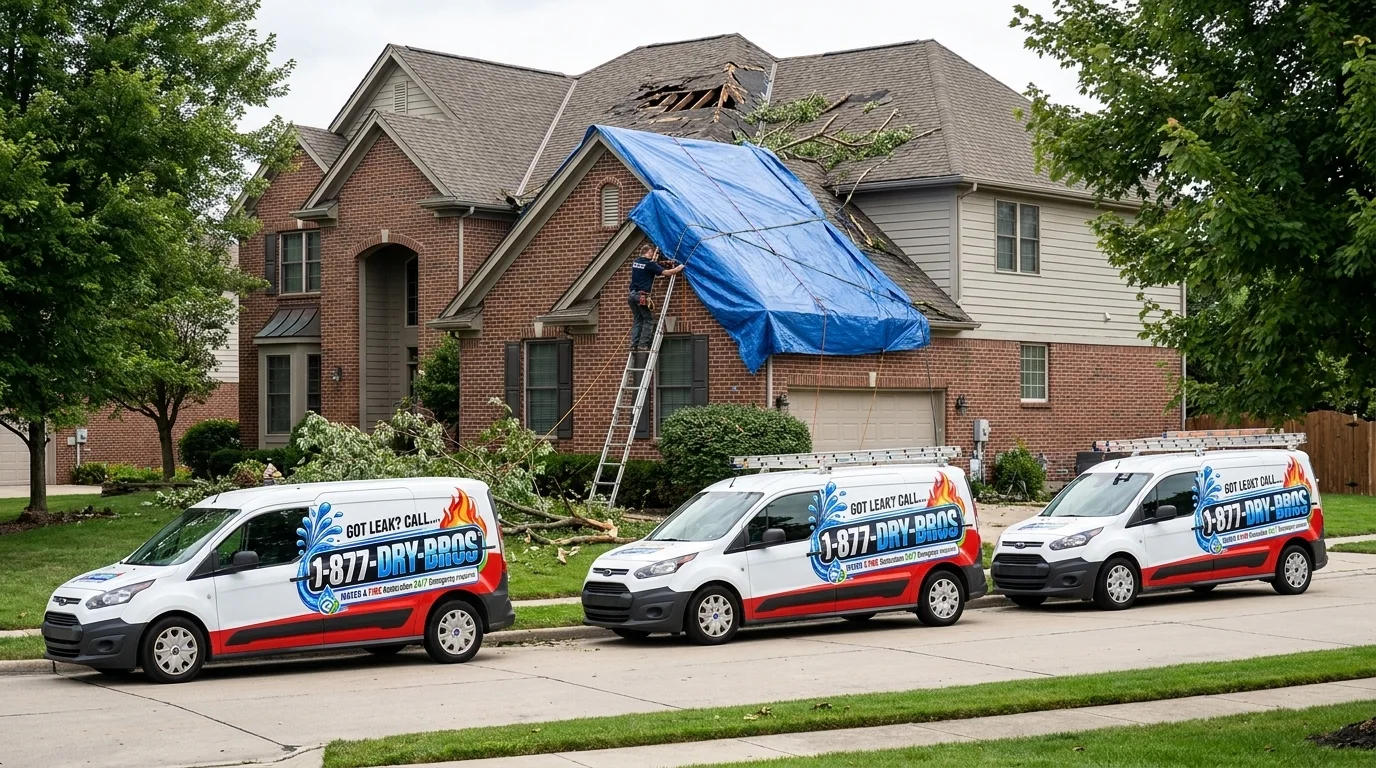
When we arrive at a storm-damaged property, the first priority is a full exterior and interior assessment before any debris is moved. Tarping an active roof breach, boarding compromised windows, and stabilizing any structural elements that could shift further, these steps happen before cleanup begins, because unsecured damage compounds fast.
Once the property is stabilized, we document everything: photographs, moisture readings, and a written scope of loss that your insurance adjuster can work from directly. Water intrusion from storm events is often multi-path, it enters through the roof, travels along rafters, pools in wall cavities, and surfaces somewhere unexpected on the floor below. We use thermal imaging and calibrated moisture meters to trace those paths rather than relying on what’s visible at the surface.
Debris removal, structural drying, and material assessment follow in sequence. Where storm water has contacted insulation, drywall, or flooring, we test and document before deciding what can be dried in place and what needs to come out. That distinction matters for your claim and for the long-term health of the structure.
Reaching Cicero from Chicago
Dry Bros operates out of Chicago, and Cicero is a direct shot west on I-290 or via Cermak Road depending on traffic and time of day. The dense grid layout of Cicero’s streets means we can reach most addresses without the access complications that come with cul-de-sac subdivisions or gated communities. For properties along the busier commercial stretches, we coordinate equipment staging in advance so we’re not losing time once we arrive.
Cicero Insurance Coordination
Storm damage claims in Illinois are generally covered under standard homeowners policies, but the documentation requirements vary by carrier and the scope of loss. We photograph and log damage in a format that aligns with how adjusters review residential storm claims, itemized by affected system (roof, exterior envelope, interior water intrusion) rather than as a single lump description. If a supplemental estimate is needed after hidden damage is uncovered during drying, we prepare that documentation as well. The goal is to keep the claim moving without requiring you to act as the go-between for every question.
Local Note
In Cicero’s older brick bungalows and two-flats, the original roof decking is often skip-sheathed, spaced boards rather than solid plywood, which was standard practice before the mid-20th century. When a storm tears away shingles or a tree limb punctures the roof surface, water doesn’t just soak into solid decking; it runs freely between the gaps and reaches the top-floor ceiling faster than most homeowners expect. Emergency tarping on these structures needs to extend further than the visible damage area, because the actual water entry point and the visible interior staining are rarely directly above each other.
If your home in Cicero has taken storm damage, roof breach, downed tree, flooded basement, or any combination, call Dry Bros Water & Fire Restoration at call us now. We’ll assess the full scope, stabilize the property, and walk you through the restoration and claims process from the first call to the final inspection.
Storm Damage Restoration in Cicero: Service Coverage
Frequently Asked Questions
How fast can you arrive for storm damage restoration in Cicero?
How quickly can Dry Bros reach a storm-damaged property in Cicero?
Cicero has a lot of older brick bungalows, does that affect how storm damage is repaired?
Does Cook County's clay soil make storm flooding worse for Cicero basements?
What's the difference between storm damage and flood damage for an insurance claim in Illinois?
Can storm damage to a Cicero home's roof lead to mold if it isn't addressed quickly?
Storm Damage Restoration response in Cicero
Most Cicero calls see a technician on-site within 60 minutes from our Chicago headquarters.