Storm Damage Restoration in Chicago
Storm damage restoration in Chicago and surrounding areas. Insurance billing accepted. Call us now.
A storm doesn’t finish its damage when the wind stops. Water pours through a roof breach for hours before anyone calls. A fallen tree compresses framing in ways that aren’t visible from the driveway. Wet insulation holds moisture against sheathing for days, and by the time a homeowner peels back the drywall, mold has already started colonizing the cavity. Storm damage restoration is the work of stopping that cascade, fast triage on the structure, controlled drying of what can be saved, and honest documentation of what can’t.
What Storm Damage Restoration actually involves
Storm damage is rarely one problem. A single severe weather event can combine wind-driven rain intrusion, structural breaching from fallen trees or debris, flooded basements from overwhelmed drainage, and broken windows that left interiors exposed for hours. Each of those entry points creates its own moisture load, and they interact in ways that a surface inspection misses.
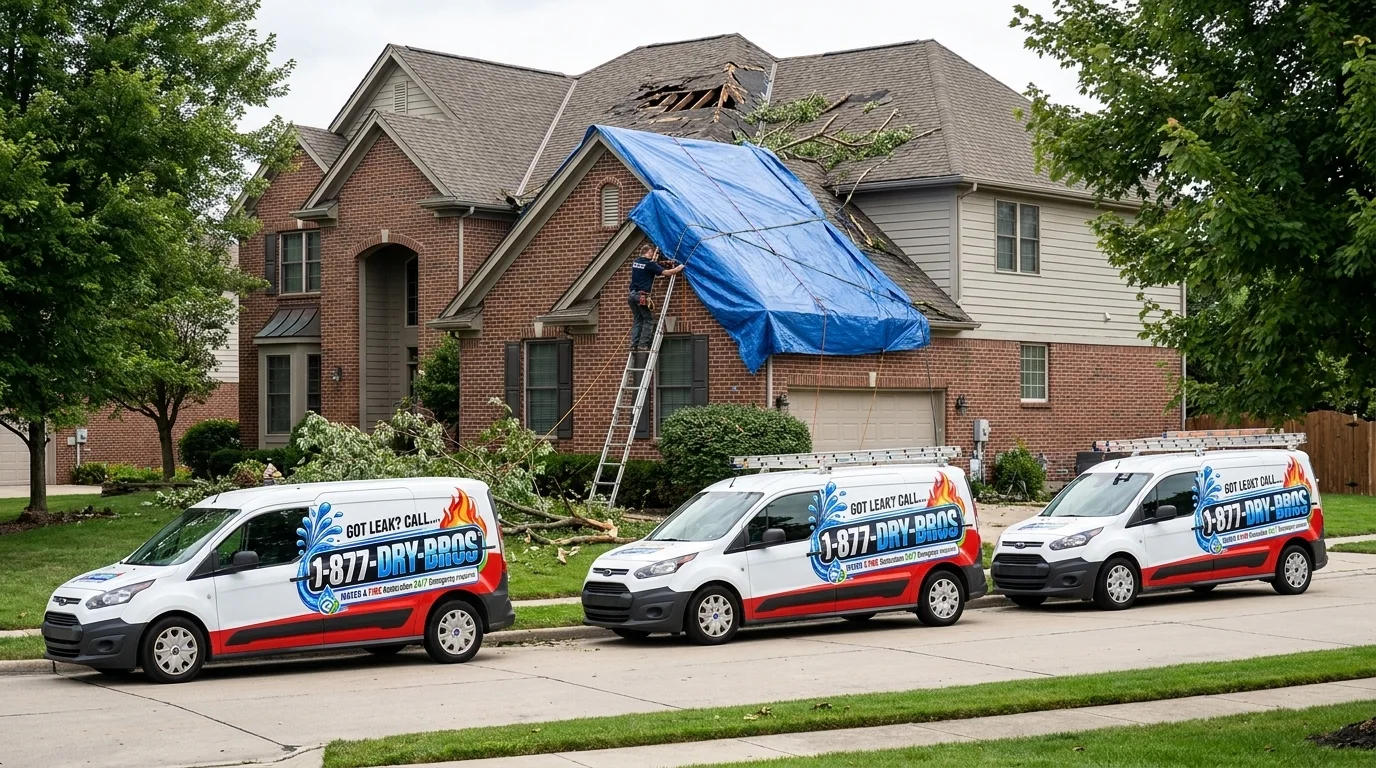
The work starts with emergency stabilization, tarping and boarding open penetrations before additional rain or wind can compound the loss. From there, the focus shifts to moisture mapping: using thermal imaging cameras and penetrating moisture meters to trace exactly how far water traveled behind walls, under flooring, and into structural cavities. In Chicago’s older housing stock, bungalows and two-flats with plaster-on-lath construction, balloon framing, and unvented crawl spaces, water can travel farther and hide longer than it would in newer platform-framed construction.
Drying equipment, industrial desiccant or refrigerant dehumidifiers, high-velocity air movers, and negative-air machines, runs continuously until every affected assembly reaches the dry standard. Structural materials are monitored daily with calibrated meters, not estimated by feel or appearance.
Our process
-
Emergency stabilization and site safety, Before any assessment begins, open penetrations get tarped or boarded, utilities are confirmed safe, and any structural hazards from tree strikes or debris are identified. This step limits additional loss and makes the property safe to work in.
-
Full-structure moisture mapping, Thermal imaging and moisture meters document every wet zone, not just the obvious ones. Water that entered through a roof breach often travels along rafters and top plates before dropping into wall cavities one or two rooms away from the visible damage. This documentation also becomes part of the insurance claim file.
-
Debris removal and selective demolition, Fallen tree limbs, displaced roofing material, and broken glass are removed. Saturated insulation, drywall, and flooring that cannot be dried in place are removed to expose the structural framing for drying, a step called “flood cuts” when it involves drywall removal at a measured height above the waterline.
-
Controlled structural drying, Drying equipment is positioned based on the moisture map, not placed generically. Air movers are directed into wall cavities through small ports when possible to preserve intact drywall. Daily moisture readings track progress and determine when equipment can be repositioned or removed.
-
Scope documentation for reconstruction, Once the structure is dry and stabilized, a written scope of work details every item requiring repair or replacement, roofing, framing, sheathing, insulation, drywall, flooring, windows. That scope goes to the insurance carrier and serves as the basis for reconstruction.
What separates a good storm damage response from a bad one
The most common failure in storm damage restoration is treating the visible damage as the complete picture. A crew that patches the roof, runs fans for two days, and leaves has addressed the symptom without confirming the structure is actually dry. Wet framing behind intact drywall will grow mold within days in Chicago’s humid summers, and that secondary damage often falls into a coverage dispute with the carrier because it developed after the initial response.
Experienced operators know that wind-driven rain penetrates differently than bulk water intrusion. It saturates wall assemblies from the outside in, often leaving the interior surface of drywall dry to the touch while the sheathing and studs behind it are at or above 20% moisture content, the threshold where wood decay and mold become active concerns.
Insurance adjusters look for a complete moisture log: baseline readings taken at the time of response, daily progress readings, and a final dry standard confirmation. A claim file without that documentation is harder to close, and a carrier may dispute secondary damage that a proper drying log would have prevented.
Tree strike claims carry their own complexity. The visible damage is the tree. The hidden damage is often deflected framing, cracked masonry, or compromised flashing that won’t show up until the next rain. A thorough scope documents the full structural impact, not just what’s visible from the ground.
What does Storm Damage Restoration cost?
Typical costs vary widely depending on the size of the affected area, how many building systems were compromised, and how long water was present before mitigation began. Most homeowners pay somewhere in the ranges below, these are industry-typical figures, not quotes, and every loss is different; Dry Bros Water & Fire Restoration provides a written scope before any work begins so there are no surprises.
| Scenario | Typical industry range |
|---|---|
| Minor roof leak, single room affected | $1,500 – $4,000 |
| Wind-driven rain, multiple rooms, no structural damage | $4,000 – $10,000 |
| Tree strike with roof breach and interior water intrusion | $8,000 – $25,000 |
| Basement flooding from storm drainage backup | $3,500 – $12,000 |
| Whole-structure event (multiple systems, extended exposure) | $20,000 – $60,000+ |
Homeowners insurance typically covers sudden and accidental storm damage, wind, hail, fallen trees, and resulting water intrusion, though flood damage from rising groundwater is generally covered under a separate flood policy rather than a standard homeowners policy.
Seasonal and regional considerations
Chicago’s storm season peaks in late spring and summer, when derecho-force straight-line winds and isolated tornadoes can move through the metro with little warning. The region’s clay-heavy soils don’t absorb heavy rainfall quickly, which means basement flooding and overwhelmed window wells are common even when a storm doesn’t produce wind damage.
Winter brings its own storm damage pattern: ice dams along rooflines, where heat loss through the attic melts snow that refreezes at the eaves and backs water under shingles. That water intrusion is slow and often goes unnoticed until staining appears on ceiling drywall, sometimes weeks after the storm that caused it.
Older Chicago neighborhoods, Bridgeport, Beverly, Avondale, and similar areas with housing stock from the early to mid-twentieth century, tend to have original roofing substrates, aging flashing, and masonry that’s more vulnerable to wind and water intrusion than newer construction. A storm that causes cosmetic damage to a newer home can cause structural damage to a 1920s two-flat.
Service area
Dry Bros serves Chicago and the surrounding region, including communities throughout Cook, DuPage, Lake, and Will counties. The city-specific pages for neighborhoods and suburbs link back here, if you’re in the metro area and dealing with storm damage, you’re in the service area.
If you’re looking at a damaged roof, standing water in a basement, or a tree through a wall, call call us now to start the triage process and get a written scope before any work begins.
Frequently Asked Questions
Does homeowners insurance cover storm damage restoration?
How do I know if water got into my walls after a storm, even if the interior looks dry?
A tree hit my roof. What structural damage might not be obvious from looking at it?
What's the difference between storm-related water intrusion and a flood, and why does it matter for my claim?
How long does structural drying take after storm water intrusion?
Looking for the best storm damage restoration company in Chicago?
Dry Bros Water & Fire Restoration provides storm damage restoration in Chicago, IL and the surrounding area. We answer calls 24/7 — call (877) 379-2767 for immediate help.
Need Storm Damage Restoration now?
We respond 24/7 across Chicago and surrounding IL cities.
Related Coverage
- Our Restoration Services
- Contact Dry Bros Water & Fire Restoration
- Storm Damage Restoration in Berwyn
- Storm Damage Restoration in Cicero
- Storm Damage Restoration in Des Plaines
- Storm Damage Restoration in Evanston
- Storm Damage Restoration in Naperville
- Storm Damage Restoration in Oak Park
- Storm Damage Restoration in Skokie