
Flood Damage Restoration in Des Plaines
Flood damage restoration in Des Plaines, IL. Insurance billing accepted. Call us now.
Our technicians are dispatched from our Chicago, IL headquarters and are typically on-site in Des Plaines within 60 minutes of your call.
Des Plaines sits at the confluence of the Des Plaines River and several tributary drainage corridors, which means flood events here aren’t always tied to a burst pipe or a backed-up appliance, sometimes the water simply arrives from outside, pushing through foundation walls, window wells, and floor drains faster than a sump pump can keep up. When that happens, the clock matters. Saturated subfloors, soaked insulation, and wet drywall don’t wait for business hours to start breaking down, and the gap between a manageable cleanup and a full structural remediation is often measured in hours, not days.
Why Des Plaines Properties See Flood Damage Issues
The city’s position in the Chicago metropolitan lowlands gives it a drainage profile that sets it apart from communities on higher ground to the west. Much of Des Plaines was developed in the mid-20th century, and the housing stock reflects that era: poured-concrete basements with older cove joints, clay-tile sewer laterals that can back up under heavy rain load, and crawl spaces with vapor barriers that weren’t designed for the sustained soil saturation that follows a multi-day storm system off Lake Michigan.
The Des Plaines River itself has a well-documented history of overbank flooding, particularly in low-lying residential corridors. When the river crests, it doesn’t just threaten homes directly adjacent to the channel, it raises the local water table broadly, which can cause hydrostatic pressure to push water through basement walls that have never leaked before. Homes that performed fine through a dozen previous storms can suddenly take on water when conditions align just wrong.
Sewer backup is a separate but related risk. Combined sewer systems in older sections of the city can become overwhelmed during intense rainfall, reversing flow through floor drains and laundry tub standpipes. That category of intrusion carries a contamination classification that changes the cleanup protocol significantly, materials that absorbed sewage-tainted water typically require removal rather than drying in place.
Our Flood Damage Restoration Process in Des Plaines
The first step on any flood job is an honest assessment of what you’re dealing with. Water source, contamination category, and how long the water has been present all shape the plan. We use moisture meters and thermal imaging to map saturation behind walls and under flooring, surface readings can be deceptive, especially in homes with older plaster construction that holds moisture deep in the substrate while feeling dry to the touch.
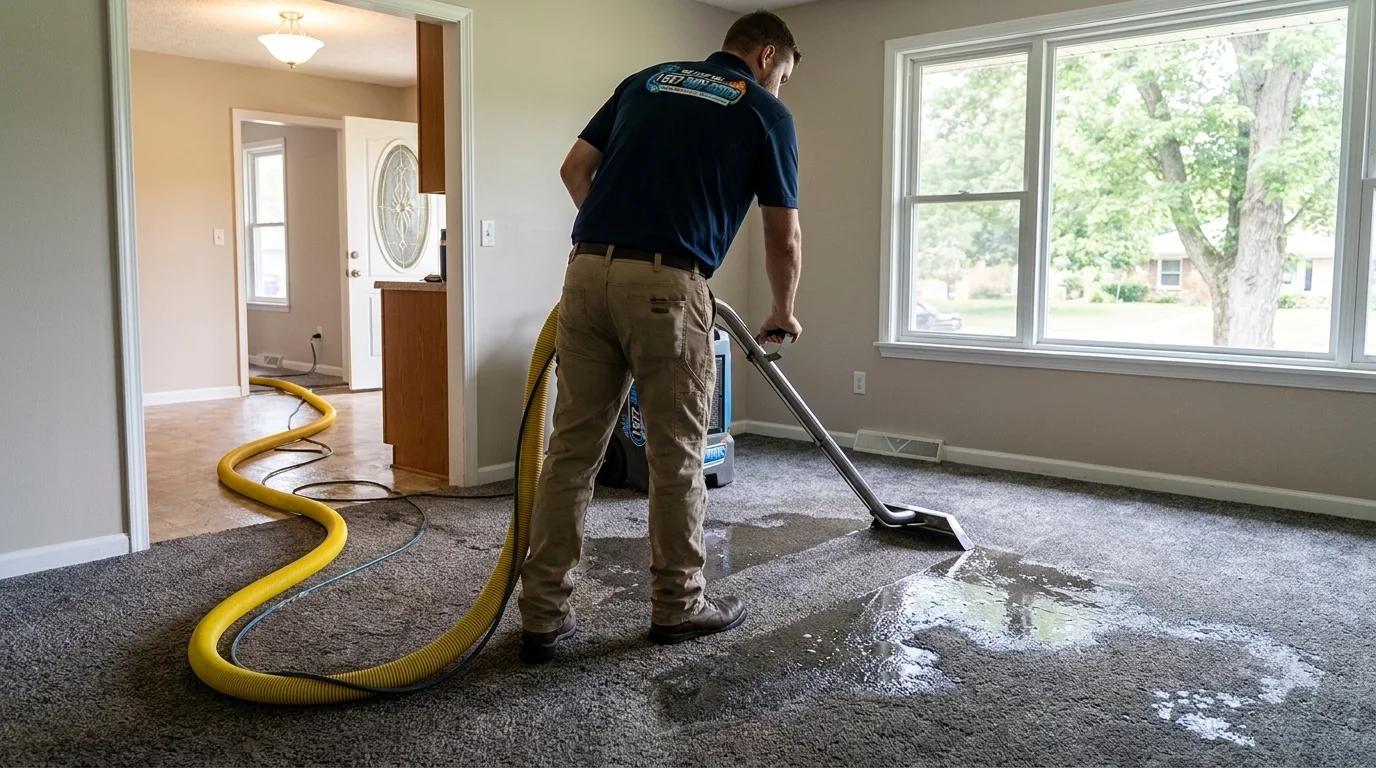
Once the scope is clear, extraction comes first. Standing water is removed with truck-mounted or portable extraction equipment, followed by targeted drying using commercial-grade desiccant and refrigerant dehumidifiers and high-velocity air movers positioned to create directed airflow through the affected cavity. In finished basements, common in Des Plaines ranch and split-level homes, that often means removing baseboards and drilling small evaporation ports to dry the wall cavity without tearing out entire panels of drywall unnecessarily.
Moisture readings are logged daily. Drying isn’t declared complete based on feel or visual inspection, it’s declared complete when the readings reach the pre-loss equilibrium moisture content for the material type. That documentation also becomes part of the claim file.
Reaching Des Plaines from Chicago
Dry Bros operates out of the Chicago area, and Des Plaines is accessible via the I-90/94 Kennedy Expressway to I-190, or via the Tri-State Tollway (I-294) from the south and west. Depending on traffic and the specific address, routing through O’Hare-adjacent corridors can add time during peak hours, if you’re calling during a weather event when multiple jobs are active, our team will give you an honest arrival estimate rather than a number we can’t stand behind.
Des Plaines Insurance Coordination
Flood claims in Des Plaines frequently involve a coverage question that catches homeowners off guard: standard homeowners policies typically exclude rising water from an external source, which is covered instead under a separate National Flood Insurance Program policy if one is in place. Sewer backup coverage is a separate endorsement still. Knowing which policy applies, and which exclusions might be contested, affects how the claim is filed.
We document the loss thoroughly from the first day on site: photos of water lines, affected materials, moisture readings, and a written scope of damage. That documentation goes to your adjuster in a format they can work with directly, which reduces back-and-forth and helps move the claim forward.
Local Note
Homes in the lower-elevation sections of Des Plaines near the river corridor frequently have older sump systems with gravity-fed discharge lines that daylight at or near grade, which means during a flood event, the discharge point can become submerged and the pump loses its ability to move water out. If your sump ran continuously during the last storm but the basement still took on water, that’s often why. A check valve on the discharge line and an elevated outlet point are straightforward fixes, and knowing to look for that condition is something that comes from working in this specific drainage environment.
If your home or property in Des Plaines has taken on water, whether from the river, a sewer backup, or an overwhelmed drainage system, call Dry Bros at call us now. We’ll assess the damage honestly, explain what the restoration process looks like for your specific situation, and get the work moving.
Flood Damage Restoration in Des Plaines: Service Coverage
Frequently Asked Questions
How fast can you arrive for flood damage restoration in Des Plaines?
Does the Des Plaines River flooding affect homes that aren't directly on the riverbank?
How does sewer backup flooding in Des Plaines change the cleanup process compared to a clean-water leak?
What should I do immediately after flooding in my Des Plaines home while I wait for your crew?
Does my homeowners insurance cover flood damage from the Des Plaines River overflowing?
How long does flood drying typically take in a Des Plaines basement with a finished ceiling and walls?
Flood Damage Restoration response in Des Plaines
Most Des Plaines calls see a technician on-site within 60 minutes from our Chicago headquarters.