Flood Damage Restoration in Evanston
Flood damage restoration in Evanston, IL. Insurance billing accepted. Call us now.
Our technicians are dispatched from our Chicago, IL headquarters and are typically on-site in Evanston within 60 minutes of your call.
Evanston sits at the edge of Lake Michigan, and that geography is never more consequential than after a heavy rain. The city’s combined sewer system, which carries both stormwater and sanitary flow in a single pipe, can back up into basements during intense precipitation events, sending contaminated water across finished floors, into wall cavities, and under slab foundations before a homeowner realizes what’s happening. Flood damage in Evanston isn’t just a wet-carpet problem; it’s a structural, sanitary, and timeline challenge that compounds fast.
Why Evanston Properties See Flood Damage Issues
Evanston’s housing stock skews old. A large share of the city’s residential buildings date to the early twentieth century, many featuring clay tile drain lines, stone or brick foundations, and basement walls that were never designed to resist hydrostatic pressure from saturated soil. When Lake Michigan storm surges push the water table upward, or when a multi-inch rainfall overwhelms the Metropolitan Water Reclamation District’s capacity, those older foundations become the first point of failure.
The city’s topography adds to the challenge. The lakefront blocks drain relatively quickly, but neighborhoods further west sit on flatter terrain where surface water moves slowly and pools against foundations. Older homes with window wells and below-grade egress points are especially vulnerable: water finds those openings before it finds a storm drain. Crawl spaces and unfinished basements in the city’s vintage two-flats and greystones can hold standing water for days if not extracted promptly, and that 24-to-48-hour window is when mold colonization begins in earnest.
Our Flood Damage Restoration Process in Evanston
Flood cleanup in an older Evanston building follows a different sequence than a straightforward pipe-burst job in a newer suburb. The first step on-site is always water classification, determining whether the intrusion is clean water, gray water, or category-three sewage backup, which is common in combined-sewer events. That classification drives every decision that follows: what PPE the crew wears, what materials can be dried in place versus what must be removed, and how the space is documented for your insurance carrier.
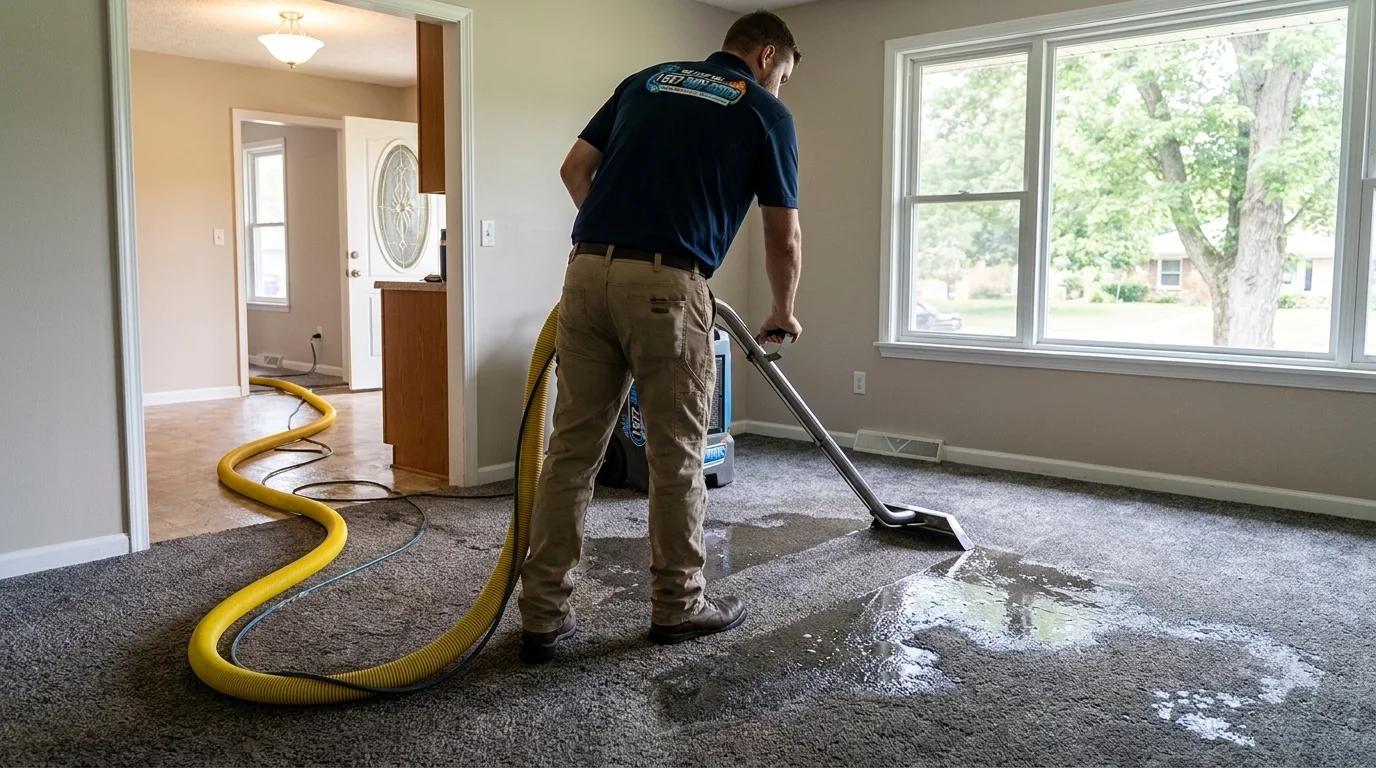
Once the source is controlled and the water category is confirmed, extraction begins using truck-mounted and portable units calibrated for the volume present. In Evanston’s plaster-and-lath construction, common in homes built before the 1950s, moisture readings at the surface can look acceptable while the lath behind the plaster stays saturated for days. Dry Bros technicians use thermal imaging and penetrating moisture meters to map the true wet zone, not just the visible one, before placing drying equipment. Structural drying in a thick-walled graystone or brick two-flat typically takes longer than in frame construction, and the drying plan reflects that reality rather than a one-size schedule.
Throughout the process, we document affected materials, moisture readings, and equipment placement in a format that aligns with what insurance adjusters need to process a claim efficiently.
Evanston Insurance Coordination
Flood damage claims in Evanston often involve a question that catches homeowners off guard: is this a sewer backup loss or a flood loss? Standard homeowners policies in Illinois typically exclude rising water but may cover sewer backup if the homeowner added that endorsement. The distinction matters because it determines which policy, and which adjuster, handles the claim.
Dry Bros works directly with insurance carriers, providing the moisture logs, photo documentation, and scope of work that adjusters require. We can also help you understand what your policy language is asking when the adjuster’s questions don’t match what you’re seeing in your basement. We don’t interpret legal contract language, but we can walk you through the restoration side of the documentation so nothing falls through the cracks.
Local Note
Evanston’s older greystones and courtyard buildings often have shared utility chases and party walls that connect adjacent units. When one unit floods, moisture can migrate laterally into a neighboring unit’s wall cavity without that neighbor seeing any visible water. In multi-unit buildings, particularly the vintage courtyard apartments common along the city’s central residential corridors, we assess adjacent spaces as part of the initial inspection, not as an afterthought. Missing that lateral spread is one of the more common reasons a flood restoration job gets called back weeks later.
If your property has been affected by flooding, call Dry Bros Water & Fire Restoration at call us now. We serve Evanston and the surrounding North Shore, and we’ll walk you through next steps from the first call, so you’re not guessing while the clock on mold growth is running.
Flood Damage Restoration in Evanston: Service Coverage
Frequently Asked Questions
How fast can you arrive for flood damage restoration in Evanston?
How does Evanston's combined sewer system affect what kind of flood damage I'm dealing with?
My Evanston home was built in the 1920s, does that affect how long flood drying takes?
Is flood damage covered by standard homeowners insurance in Evanston, or do I need a separate policy?
Can flood moisture spread from my unit into a neighboring unit in an Evanston multi-unit building?
What equipment is used for flood drying, and how long will it be running in my home?
Flood Damage Restoration response in Evanston
Most Evanston calls see a technician on-site within 60 minutes from our Chicago headquarters.