Basement Flooding Cleanup in Oak Park
Basement flooding cleanup in Oak Park, IL. Insurance billing accepted. Call us now.
Our technicians are dispatched from our Chicago, IL headquarters and are typically on-site in Oak Park within 60 minutes of your call.
Oak Park sits on some of the flattest, most clay-dense ground in Cook County, and when a heavy rain event overwhelms the combined sewer system that serves much of this village, that clay has nowhere to send the water except into the basements of the bungalows, Foursquares, and Prairie-style homes that line street after street here. A flooded basement in Oak Park isn’t just a puddle problem. It’s standing water against century-old stone foundations, saturated floor joists that haven’t dried since they were milled, and a clock ticking toward mold colonization in as little as 24 to 48 hours. Dry Bros Water & Fire Restoration responds to exactly this kind of loss, extraction, structural drying, and documentation, so you’re not left guessing what comes next.
Why Oak Park Basements Flood the Way They Do
The village’s housing stock skews heavily pre-1950, and that era of construction came with full-depth basements finished in stone rubble or poured concrete that was never designed to be waterproof in the modern sense. Parging cracks. Mortar joints erode. Window wells fill faster than their drains can clear. When the Metropolitan Water Reclamation District’s combined sewer infrastructure backs up during a significant storm, the kind that drops two or three inches of rain in under an hour, hydrostatic pressure pushes water through every gap it can find.
The clay-heavy soils throughout Cook County compound this. Unlike sandy or loamy ground that absorbs rainfall and lets it percolate, the tight clay beneath Oak Park’s streets and yards sheds water laterally. That water finds the path of least resistance: the exterior face of your foundation wall. Sump pits that haven’t been tested since last spring, check valves that have never been replaced, and floor drains that connect directly to the combined sewer are the three most common failure points we see on these calls.
What Basement Flooding Cleanup Looks Like Here
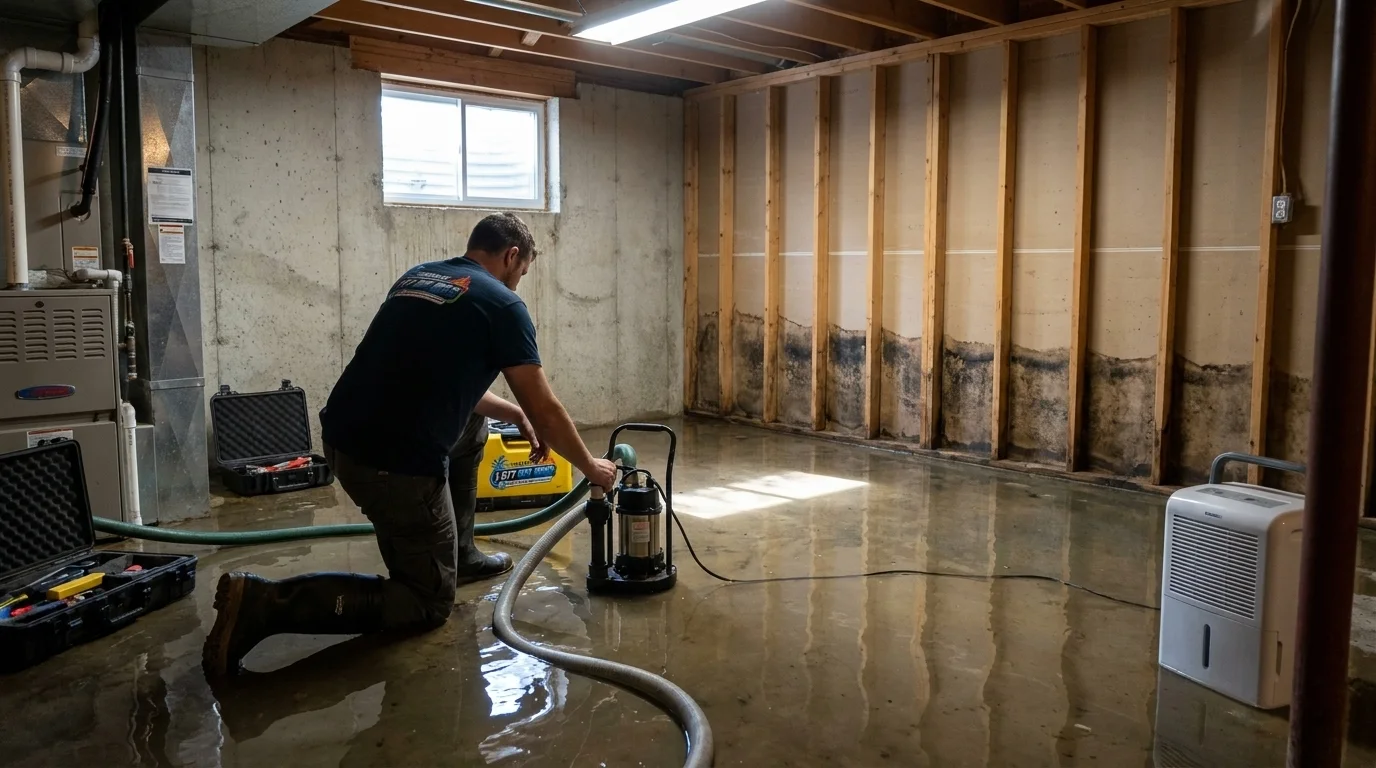
Every flooded basement cleanup starts with the same question: where is the water still coming from? We don’t begin extraction until the source is controlled or isolated, because pulling water out of a space that’s still taking on water is a losing effort. Once the entry point is addressed, whether that’s a failed sump, a cracked wall, or a backed-up floor drain, the process moves through distinct phases.
Water extraction uses truck-mounted and portable extractors to pull standing water from the floor, from carpet and pad if present, and from the base of finished walls. In Oak Park’s older homes, finished basements often have wood-paneled walls or plaster over furring strips, materials that wick moisture upward faster than modern drywall and hold it longer.
Moisture mapping follows immediately. Thermal imaging cameras and calibrated moisture meters let us read what’s happening behind surfaces, not just at them. A basement floor that feels dry underfoot can register elevated moisture six inches into the concrete slab. We document every reading because your insurance adjuster will ask for it.
Structural drying uses industrial air movers and dehumidifiers placed according to the room’s geometry and airflow. In a low-ceiling Oak Park basement with a stone foundation, we adjust equipment placement to account for the fact that stone walls release absorbed moisture slowly and over days, not hours.
Daily monitoring tracks psychrometric readings until the structure reaches the dry standard. We don’t pull equipment early because a number looks close enough.
Reaching Oak Park from Chicago
Dry Bros operates out of Chicago, and Oak Park sits directly on the western edge of the city, accessible via the Eisenhower Expressway (I-290) to the Harlem Avenue or Oak Park Avenue exits, or surface routes through the Austin neighborhood when the expressway is congested. The village’s compact grid means that once we’re in Oak Park, travel between the north end near North Avenue and the south end near Roosevelt Road adds only minutes. We schedule arrival windows honestly rather than quoting response times we can’t guarantee.
Oak Park Insurance Coordination
Most standard homeowners policies in Illinois distinguish between sewer backup and surface water flooding, and that distinction matters enormously for Oak Park homeowners whose basements flood during combined sewer surcharge events. We photograph the loss systematically, document moisture readings in a format adjusters recognize, and can communicate directly with your carrier’s claims team. If you have a sewer backup rider on your policy, that documentation is what gets the claim approved. If you don’t, we can walk you through what the out-of-pocket scope looks like before any work begins.
Local Note
Oak Park’s older Prairie-style and Foursquare homes frequently have basement walls built from limestone rubble or soft common brick rather than poured concrete, materials that were never intended to hold back groundwater under pressure. When these walls take on water during a sewer surcharge event, the moisture doesn’t just sit at the surface. It wicks into the mortar and the brick itself, and a meter reading taken at the wall face can look acceptable while the interior of the wall is still saturated. We take readings at multiple depths and flag this to homeowners and adjusters alike, because drying a rubble or brick foundation wall to an acceptable standard takes longer than drying a poured concrete wall of the same thickness, and skipping that step is how mold problems start inside the wall cavity weeks after the visible water is gone.
If your basement took on water, call Dry Bros now. We’ll assess the loss, explain the process, and give you a clear picture of what cleanup and drying will involve for your specific Oak Park home, before anything gets signed.
Basement Flooding Cleanup in Oak Park: Service Coverage
Frequently Asked Questions
How fast can you arrive for basement flooding cleanup in Oak Park?
Are Oak Park's older stone and brick foundation homes harder to dry after a basement flood?
My basement flooded during a heavy rain, is that covered by my Oak Park homeowners policy?
How does Oak Park's clay soil affect basement flooding risk compared to other Chicago suburbs?
What equipment do you use for basement water removal, and how long does drying typically take?
Can you access basements in Oak Park's densely built neighborhoods without disrupting neighbors?
Will my homeowners insurance cover basement flooding cleanup in Oak Park?
Basement Flooding Cleanup response in Oak Park
Most Oak Park calls see a technician on-site within 60 minutes from our Chicago headquarters.