Basement Flooding Cleanup in Chicago
Basement flooding cleanup in Chicago and surrounding areas. Insurance billing accepted. Call us now.
Standing water in a basement moves fast. Within the first hour, it wicks into drywall, soaks into fiberglass insulation, and begins saturating the concrete slab beneath your flooring. By hour 24, the conditions that allow mold to colonize are already forming behind walls you cannot see. Basement flooding is not a cleanup problem, it is a structural drying race, and the clock started the moment water entered the space.
What basement flooding cleanup actually involves
Basement flooding cleanup is categorically different from mopping up a spill or running a shop vac after a minor leak. A flooded basement typically involves large volumes of water that have migrated into building materials, concrete block foundations, wood-framed walls, subflooring, and any contents stored at floor level.
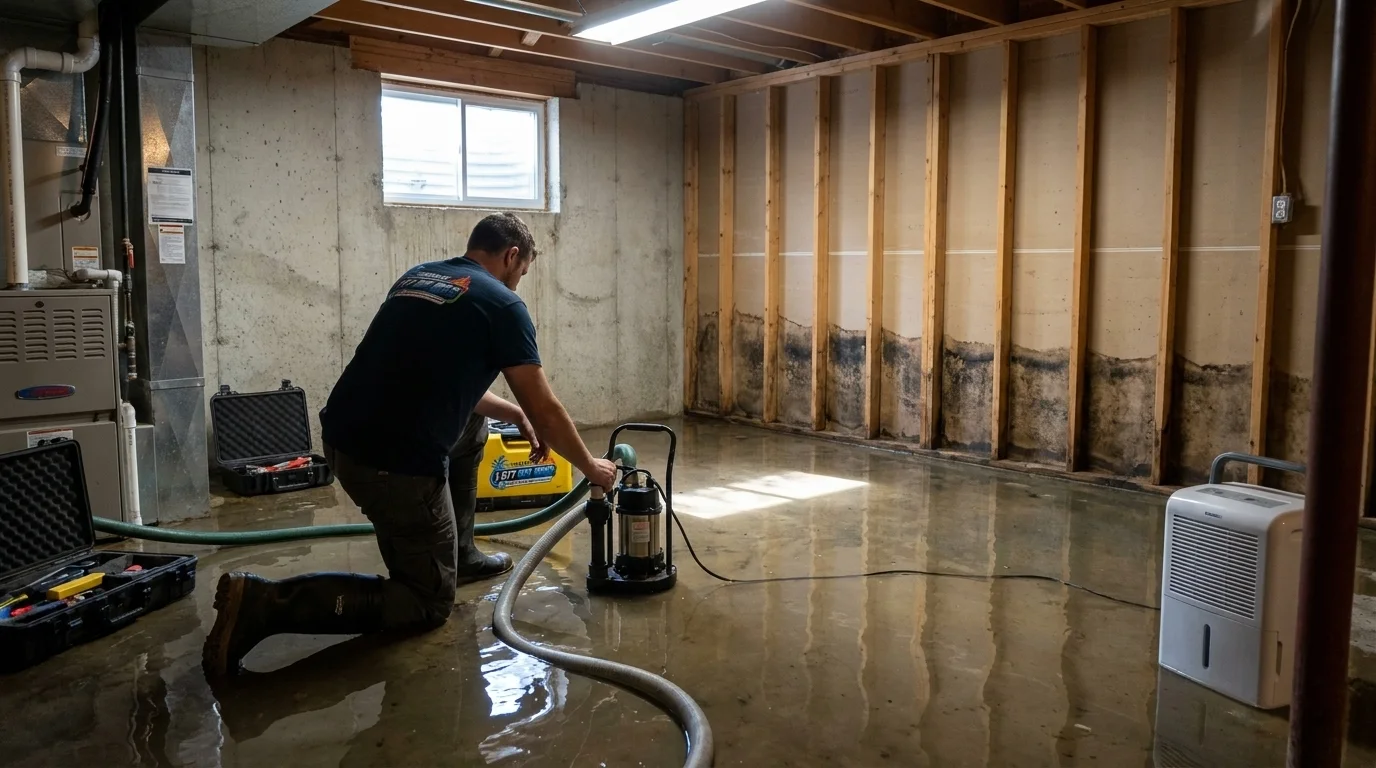
The work requires truck-mounted or high-capacity submersible pumps to remove standing water, followed by industrial air movers and low-grain refrigerant (LGR) dehumidifiers positioned to create a controlled drying envelope. Moisture meters and thermal imaging cameras map where water has traveled beyond what is visible to the eye. In many Chicago-area basements, particularly older brick two-flats and bungalows with plaster walls over wood lath, water travels further and hides longer than it does in newer drywall construction.
The drying phase is not complete when the floor feels dry underfoot. Structural drying is measured in psychrometric data: temperature, relative humidity, and grain-per-pound readings tracked daily until materials return to acceptable moisture content. That process typically runs several days, sometimes longer depending on the depth of saturation and the construction of the space.
Our process
1. Source control and safety assessment Before extraction begins, the entry point for water is identified and, where possible, stopped. This matters because continuing infiltration defeats drying. The space is also assessed for electrical hazards, a flooded basement with energized outlets or a submerged sump pump is not safe to enter without shutting power at the panel.
2. Standing water extraction Submersible pumps handle bulk water removal. Once standing water is below pump-intake depth, wet vacuums and extraction wands pull residual water from carpet, flooring seams, and low points. Sewage-involved flooding (Category 3) requires full PPE and separate waste handling protocols.
3. Controlled demolition of non-salvageable materials Wet drywall, saturated insulation, and soaked carpet padding do not dry, they hold moisture and become mold substrate. These materials are removed to the flood cut line (typically 12 inches above the highest water mark) to expose the wall cavity and allow air circulation to reach the framing and sheathing behind.
4. Structural drying with daily moisture monitoring Air movers and LGR dehumidifiers are placed according to the square footage and layout of the space. Readings are logged daily. Equipment is repositioned as materials dry and airflow patterns shift. Drying is not declared complete until moisture readings in framing, concrete, and any remaining building materials reach target levels, not when the room looks or smells dry.
5. Antimicrobial treatment and clearance documentation Once structural drying goals are met, affected surfaces receive an EPA-registered antimicrobial treatment. A written drying log, including daily psychrometric readings and before/after moisture documentation, is produced for the insurance claim file and for any future buyer disclosure.
What separates a good basement flooding response from a bad one
The most common failure in basement flooding cleanup is stopping at extraction. A crew that pumps out the water, runs a dehumidifier for a day, and declares the job done has not addressed what is happening inside the wall cavities and under the slab. Moisture meters at the surface can read within acceptable range while the lath, framing, or concrete block behind remains saturated, a condition that produces mold growth within weeks.
A second common error is skipping the flood cut. Leaving wet drywall and insulation in place to “see if it dries” almost always results in mold remediation costs that dwarf what controlled demolition would have cost on day one.
Insurance adjusters reviewing a basement flooding claim look for a drying log with daily psychrometric readings, documentation of the water category (clean supply line, gray water, or sewage), photo documentation of water lines and affected materials, and a written scope of work produced before demolition begins. Claims without this documentation are harder to close and more likely to result in disputes over scope.
What does basement flooding cleanup cost?
Typical costs for basement flooding cleanup vary significantly based on the volume of water, the category of water involved, and how much building material requires removal. Most homeowners pay somewhere in the ranges below, these are industry-typical figures, not quotes.
| Scenario | Typical range |
|---|---|
| Minor flooding, clean water, no material removal | $1,200 – $3,500 |
| Moderate flooding, clean or gray water, partial flood cut | $3,500 – $7,000 |
| Finished basement, extensive drywall and flooring removal | $6,000 – $14,000 |
| Sewage backup (Category 3), full remediation protocol | $7,000 – $20,000+ |
| Sump failure with mold involvement | $8,000 – $18,000 |
Every loss is different, Dry Bros provides a written scope of work before any work begins so there are no surprises. Standard homeowners insurance typically covers sudden and accidental water damage (burst pipe, appliance failure, storm-driven entry) but often excludes gradual seepage and ground-level flooding without a separate flood endorsement; your adjuster can confirm what your specific policy covers.
Seasonal and regional considerations
Chicago basements face a particular combination of stressors. Spring snowmelt and heavy rain events in April and May are the peak period for sump pump failures and window-well flooding. The clay-heavy soil across much of Cook County drains slowly, which means water pools against foundation walls long after a storm passes. Freeze-thaw cycles through winter and early spring stress foundation mortar and parging, creating new infiltration points each year. Older Chicago bungalows and two-flats, many built before 1950 with rubble-stone or unreinforced concrete block foundations, are especially susceptible to lateral seepage after prolonged wet periods.
Service area
Dry Bros serves Chicago and the surrounding metro area, including communities throughout Cook, DuPage, Lake, and Will counties. Dedicated service pages for specific cities and neighborhoods link back here for full process detail.
If water is in your basement right now, call Dry Bros at call us now to schedule your moisture assessment and get a written scope before work begins.
Frequently Asked Questions
Does homeowners insurance cover basement flooding cleanup?
How do I know if my basement is actually dry after flooding?
What is a "flood cut" and does my basement actually need one?
My basement flooded from a sewage backup. Is that handled differently than clean water?
How long does it take to dry out a flooded basement?
Looking for the best basement flooding cleanup company in Chicago?
Dry Bros Water & Fire Restoration provides basement flooding cleanup in Chicago, IL and the surrounding area. We answer calls 24/7 — call (877) 379-2767 for immediate help.
Need Basement Flooding Cleanup now?
We respond 24/7 across Chicago and surrounding IL cities.
Related Coverage
- Our Restoration Services
- Contact Dry Bros Water & Fire Restoration
- Basement Flooding Cleanup in Berwyn
- Basement Flooding Cleanup in Cicero
- Basement Flooding Cleanup in Des Plaines
- Basement Flooding Cleanup in Evanston
- Basement Flooding Cleanup in Naperville
- Basement Flooding Cleanup in Oak Park
- Basement Flooding Cleanup in Skokie