
Basement Flooding Cleanup in Skokie
Basement flooding cleanup in Skokie, IL. Insurance billing accepted. Call us now.
Our technicians are dispatched from our Chicago, IL headquarters and are typically on-site in Skokie within 60 minutes of your call.
Skokie sits on the flat, clay-heavy glacial lakebed that underlies much of the North Shore, and that soil profile is one of the main reasons basements here flood so readily. When heavy rain saturates ground that drains slowly, hydrostatic pressure builds against foundation walls fast, and once water finds a crack in a poured-concrete or block foundation, it doesn’t trickle in, it pushes. If you’re standing in a wet basement right now, call Dry Bros Water & Fire Restoration now and we’ll walk you through immediate steps while we get a crew scheduled.
Why Skokie Properties See Basement Flooding So Often
The geology here is unforgiving. The clay-dominant soil that stretches across Cook County holds moisture rather than absorbing it, so even a moderate storm can overwhelm a sump pump that worked fine all last summer. Skokie’s housing stock compounds the problem: a large share of the city’s single-family homes were built between the late 1940s and the mid-1960s, when basement waterproofing standards were minimal and drain tile systems were installed in clay pipe that cracks, offsets, and collapses with age.
Flat lots, and Skokie has very few that slope meaningfully away from the foundation, mean surface water has nowhere to go except down. Window wells fill, door thresholds leak, and floor drains back up when the municipal system is at capacity. The Metropolitan Water Reclamation District’s deep tunnel system has reduced major sewer surcharges compared to decades past, but combined sewer events still occur during intense storms, and when they do, floor drains can become entry points rather than exits.
Our Basement Flooding Cleanup Process in Skokie
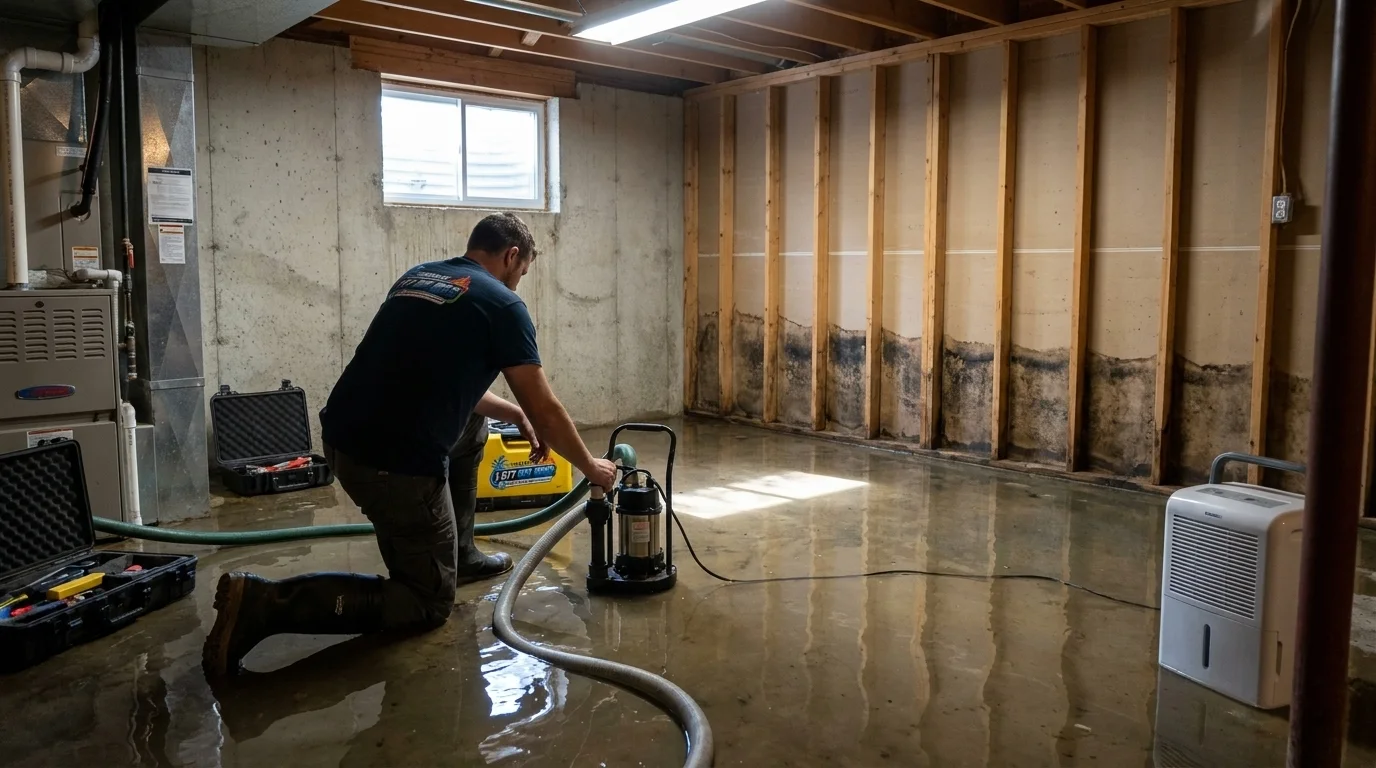
The first priority is stopping ongoing water entry if it hasn’t stopped on its own, a sump pump failure, a backed-up floor drain, or a cracked wall each requires a different immediate response before extraction begins. Once the source is controlled, we extract standing water using truck-mounted and portable extraction units. In a typical Skokie basement with 1–2 inches of standing water, extraction takes a fraction of the total drying time; the real work is what comes next.
Concrete and masonry absorb water deeply, and older block foundations common in Skokie’s mid-century homes can hold moisture in cavities that a surface reading won’t detect. We use thermal imaging and penetrating moisture meters to map the actual wet zone rather than guessing at a drying perimeter. Desiccant and refrigerant dehumidifiers are positioned based on that map, and we monitor daily, adjusting equipment placement as the drying front moves through the structure. Finished basements with drywall and insulation require more aggressive monitoring because wet insulation behind drywall can stay saturated long after the visible surface feels dry.
Skokie’s Older Homes: What That Means for Basement Drying
Homes built in the postwar decades that make up a substantial part of Skokie’s residential neighborhoods were often finished with materials that behave differently from modern construction. Plaster-and-lath ceilings in partially finished basements absorb water more slowly than drywall but release it slowly too, which extends drying timelines. Asbestos-containing floor tiles, a common find in pre-1980 Skokie basements, cannot be disturbed during water removal without proper handling protocols. If we see suspect floor tile during an inspection, we flag it before any extraction equipment contacts it, so you’re not inadvertently creating a separate remediation problem.
Older cast-iron and galvanized drain lines in these homes are also worth a look after a flood event. A backup that looks like a storm-related surcharge can sometimes point to a partially blocked line that will cause the next flood on its own.
Coordinating with Insurance After a Skokie Basement Flood
Most homeowner policies in Illinois distinguish between sudden and accidental discharge, a burst pipe, for example, and gradual seepage or surface water flooding, which typically requires a separate flood policy through the National Flood Insurance Program. Knowing which category your loss falls into matters before you start cleanup, because the documentation requirements differ. We photograph and document conditions before extraction begins, preserving the evidence your adjuster needs to evaluate the claim. We work directly with most major carriers and can communicate scope and drying logs in the format adjusters expect, which tends to move the process faster than submitting paperwork after the fact.
Local Note
Skokie’s mid-century ranch and raised-ranch homes often have a utility chase, a small vertical shaft where plumbing and HVAC lines run between the basement and the first floor, and these chases are a hidden migration path for water and humidity. During a basement flood, moisture can wick up through the chase and affect first-floor subfloor and wall cavities before any visible sign appears upstairs. It’s a detail that matters specifically in this housing stock, and it’s one reason we extend our moisture mapping above the basement level on homes of that era rather than treating the basement as a contained zone.
If your basement has taken on water, don’t wait to see whether it dries on its own, mold colonization can begin within 24 to 48 hours in the warm, humid conditions a flooded basement creates. Call Dry Bros Water & Fire Restoration now to schedule an assessment and get the drying process started before secondary damage compounds the original loss.
Basement Flooding Cleanup in Skokie: Service Coverage
Frequently Asked Questions
How fast can you arrive for basement flooding cleanup in Skokie?
Does Skokie's clay soil make basement flooding worse than in other Chicago suburbs?
My Skokie home was built in the 1950s and has old floor tiles in the basement. Does that affect the cleanup?
How does a combined sewer backup in Skokie differ from a regular basement flood, and does it change the cleanup?
What does the drying timeline look like for a finished basement in Skokie?
Will my Illinois homeowner's policy cover basement flooding from a storm, or do I need a separate flood policy?
Will my homeowners insurance cover basement flooding cleanup in Skokie?
Basement Flooding Cleanup response in Skokie
Most Skokie calls see a technician on-site within 60 minutes from our Chicago headquarters.