Flood Damage Restoration in Skokie
Flood damage restoration in Skokie, IL. Insurance billing accepted. Call us now.
Our technicians are dispatched from our Chicago, IL headquarters and are typically on-site in Skokie within 60 minutes of your call.
Skokie sits on the flat, clay-heavy glacial lakebed that underlies much of northeastern Cook County, and that soil doesn’t drain. When a heavy rain event overwhelms the combined sewer system, or when snowmelt saturates the ground faster than it can percolate, water finds the path of least resistance: basement floor drains, window wells, and the cracks in the concrete block foundations common to the village’s postwar housing stock. If you’re dealing with standing water in your home right now, the clock matters more than you might realize, mold can begin colonizing wet framing within 24 to 48 hours of a flood event.
Why Skokie Properties Are Prone to Flood Damage
Most of Skokie’s residential neighborhoods were built out between the late 1940s and the early 1970s, a period when basement construction relied heavily on concrete block rather than poured concrete. Block foundations develop hairline cracks over decades, and those cracks become entry points whenever the water table rises or a storm overwhelms the Metropolitan Water Reclamation District’s combined sewer infrastructure. The MWRD serves this area, and during significant rain events, sewer backups are a documented and recurring problem for Cook County communities, Skokie included.
The village’s relatively flat topography means there’s little natural grade to carry surface water away from foundations. Downspouts that discharge too close to the house, settled window wells without working drains, and aging sump pumps that fail under load are all common contributors to the flood calls we receive from this area. Homes with finished basements face compounded losses: carpet, drywall, insulation, and stored contents can all be destroyed within hours of water intrusion.
Our Flood Damage Restoration Process in Skokie
Flood cleanup isn’t just extraction, it’s a sequenced process that has to account for what’s hidden behind walls and under flooring, not just what’s visible on the surface.
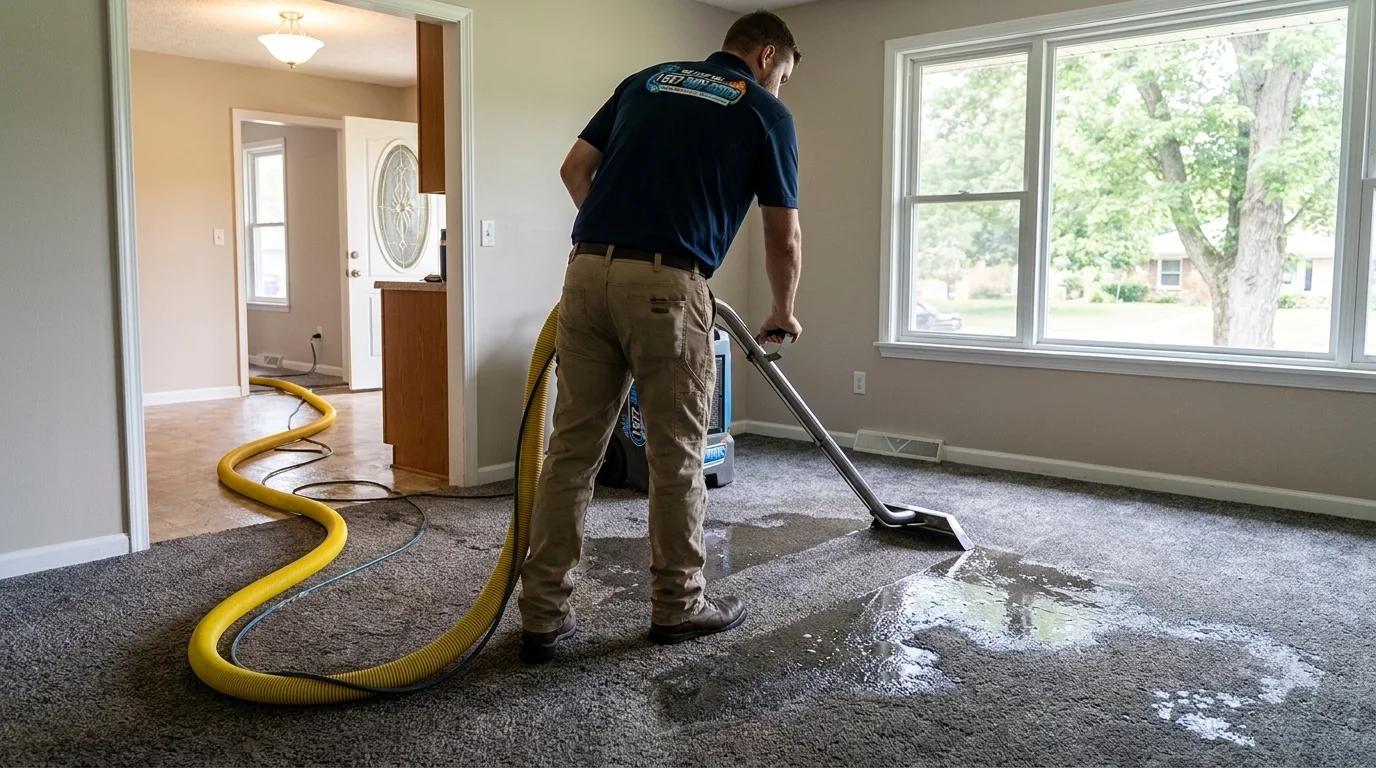
Water extraction and containment come first. We use truck-mounted and portable extraction units to remove standing water, then transition to targeted drying equipment, industrial air movers and desiccant or refrigerant dehumidifiers, positioned to pull moisture out of the structure itself, not just the air.
Moisture mapping follows immediately. Concrete block walls in Skokie’s older homes can read dry at the surface while holding significant moisture behind the parging or within the block cavities. Thermal imaging and calibrated moisture meters tell us what the eye can’t see.
Material assessment and controlled demolition happen where necessary. Saturated fiberglass insulation holds water against wood framing and accelerates decay; it almost always needs to come out. Drywall that has wicked water above the flood line gets cut back to dry material. We document every step photographically, which matters when you’re filing a claim.
Drying verification closes the job. We don’t sign off until readings confirm the structure has returned to an acceptable moisture range, not just until it looks dry.
Reaching Skokie from Chicago
Dry Bros is based in Chicago, and Skokie is a direct run up the Edens Expressway (I-94) or along surface routes like Dempster Street and Oakton Street depending on traffic. The village is compact enough that once we’re in Skokie, we can reach addresses across the community without significant transit time between them. When you call, let us know your cross streets, we’ll give you an honest estimate of when to expect us.
Working with Insurance on Skokie Flood Claims
Flood damage coverage in Illinois can be complicated. Standard homeowners policies typically exclude rising water from outside the structure (the legal definition of a flood), but they often do cover sudden and accidental discharge, a burst pipe, a failed sump pump, or a sewer backup if you carry that rider. Knowing which type of event caused your loss affects how your claim is categorized and what gets covered.
We document losses thoroughly: photos, moisture readings, affected material inventories, and drying logs. That documentation is what adjusters need to process a claim accurately. We work with most major carriers and can communicate directly with your adjuster to reduce the back-and-forth on your end.
Local Note
Skokie’s postwar ranch and split-level homes were often built with a construction detail that surprises homeowners during flood events: the subfloor extends under the finished drywall at the base of basement walls, and water that appears to stop at the wall face has frequently traveled laterally under the floor. We probe and meter along the full perimeter of flooded spaces, not just the obvious wet zone, because missing that lateral migration means leaving moisture in the structure that will produce odor and mold weeks after the visible damage appears dry.
If you’re dealing with flood damage in Skokie, call Dry Bros Water & Fire Restoration at call us now. We’ll assess the full scope of the loss, walk you through the process, and get drying equipment in place before the damage compounds further.
Flood Damage Restoration in Skokie: Service Coverage
Frequently Asked Questions
How fast can you arrive for flood damage restoration in Skokie?
Why do so many Skokie basements flood even when it hasn't rained that hard?
Does the type of foundation common in Skokie's older homes affect how long flood drying takes?
My Skokie home has a finished basement, does that change the restoration process?
Will my homeowners insurance cover a basement flood in Skokie?
How quickly can Dry Bros reach a flood emergency in Skokie from the Chicago area?
Flood Damage Restoration response in Skokie
Most Skokie calls see a technician on-site within 60 minutes from our Chicago headquarters.