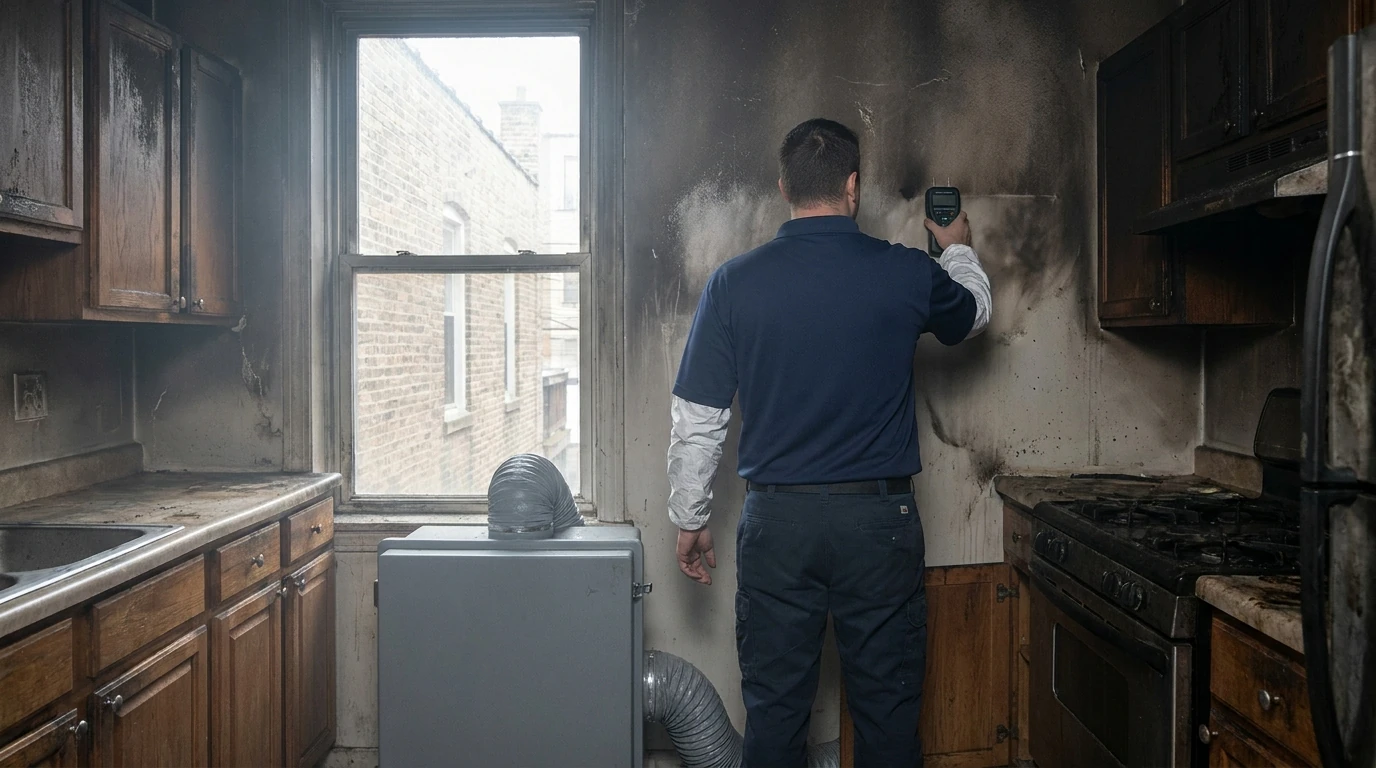
TL;DR: Fire damage restoration cost in Chicago typically runs from $1,500 for smoke-and-odor cleanup in one or two rooms to $250,000 or more for a whole-house rebuild after structural loss. Most contained kitchen fires in a Chicago two-flat or bungalow land between $8,000 and $45,000 once soot cleaning, odor treatment, and drywall or cabinet replacement are included. Your homeowners policy typically covers the loss minus your deductible, and a written scope of work is what gets your claim paid accurately.
If you just had a grease fire flare up in your kitchen, or an electrical fire spread into the wall cavity of your Oak Park bungalow, the first real question isn’t “how does fire restoration work,” it’s “what is this going to cost me.” The honest answer depends on how far the fire spread, how much smoke traveled through the HVAC system, and whether your building is a detached single-family home or a shared-wall two-flat where smoke can migrate into a neighboring unit. Here’s what homeowners across Chicago and the near suburbs actually pay, broken out by scope.
How much does fire damage restoration cost in Chicago?
Most Chicago-area fire restoration jobs fall between $1,500 for a smoke-only room and $250,000+ for a full structural rebuild, with the bulk of residential claims landing in the $8,000 to $90,000 range. The number depends almost entirely on how much of the structure burned versus how much just took on smoke and soot.
These are typical industry ranges for the Chicago market, not a quote. Every fire is different, and Dry Bros provides a written scope of work and line-item estimate before any work begins.
| Scope | Typical Chicago cost range |
|---|---|
| Smoke and odor only, 1-2 rooms, no structural loss | $1,500 - $4,000 |
| Contained kitchen fire (cabinets, drywall, some subfloor) | $8,000 - $25,000 |
| Single room with structural damage (studs, framing, subfloor) | $20,000 - $45,000 |
| Multi-room fire or whole-floor smoke damage in a two-flat | $40,000 - $90,000 |
| Emergency board-up and roof/window tarping (stabilization) | $300 - $1,500 |
| Whole-house fire with major structural loss and rebuild | $100,000 - $250,000+ |
What drives fire restoration cost up or down in a Chicago home?
The biggest cost drivers are how far the fire burned structurally, how far smoke traveled through the building, and what the local housing stock requires to repair correctly. Square footage matters less than the class of damage and the materials affected.
Chicago’s housing mix adds a few wrinkles you won’t see in newer suburban construction. A fire in a frame bungalow with balloon framing can let smoke and heat travel vertically through the wall cavities faster than in platform-framed homes, carrying soot into rooms far from the fire’s origin. In a shared-wall two-flat or three-flat, smoke odor frequently crosses into the neighboring unit through party walls and shared HVAC chases, which means a single-unit fire can turn into a multi-unit remediation job.
Structural rebuild work inside Chicago city limits also requires a City of Chicago building permit for load-bearing repairs, electrical work, and most drywall-to-stud reconstruction. Permit review timelines and inspection scheduling affect your overall project timeline more than they affect the dollar figure, but they’re worth asking about up front so your contractor is pulling permits, not skipping them.
How much does smoke and soot cleanup cost on its own?
Smoke and soot cleanup without structural repair typically runs $1,500 to $6,000 for a single affected room and scales with square footage and how deeply soot penetrated porous materials. Protein residue from a kitchen fire (a thin, hard-to-see film with a strong odor) often costs more to remediate than dry-smoke residue from a fast-burning fire, because it requires specialized cleaning agents rather than dry sponging.
Odor removal is usually priced separately from surface cleaning. Thermal fogging or hydroxyl generator treatment for whole-house odor typically adds $300 to $1,200 depending on how many rooms need treatment and how long the generators need to run. If soot reached HVAC ductwork, which is common even in a contained kitchen fire because the system was running when the fire started, duct cleaning is its own line item.
How much does fire damage debris removal cost in Chicago?
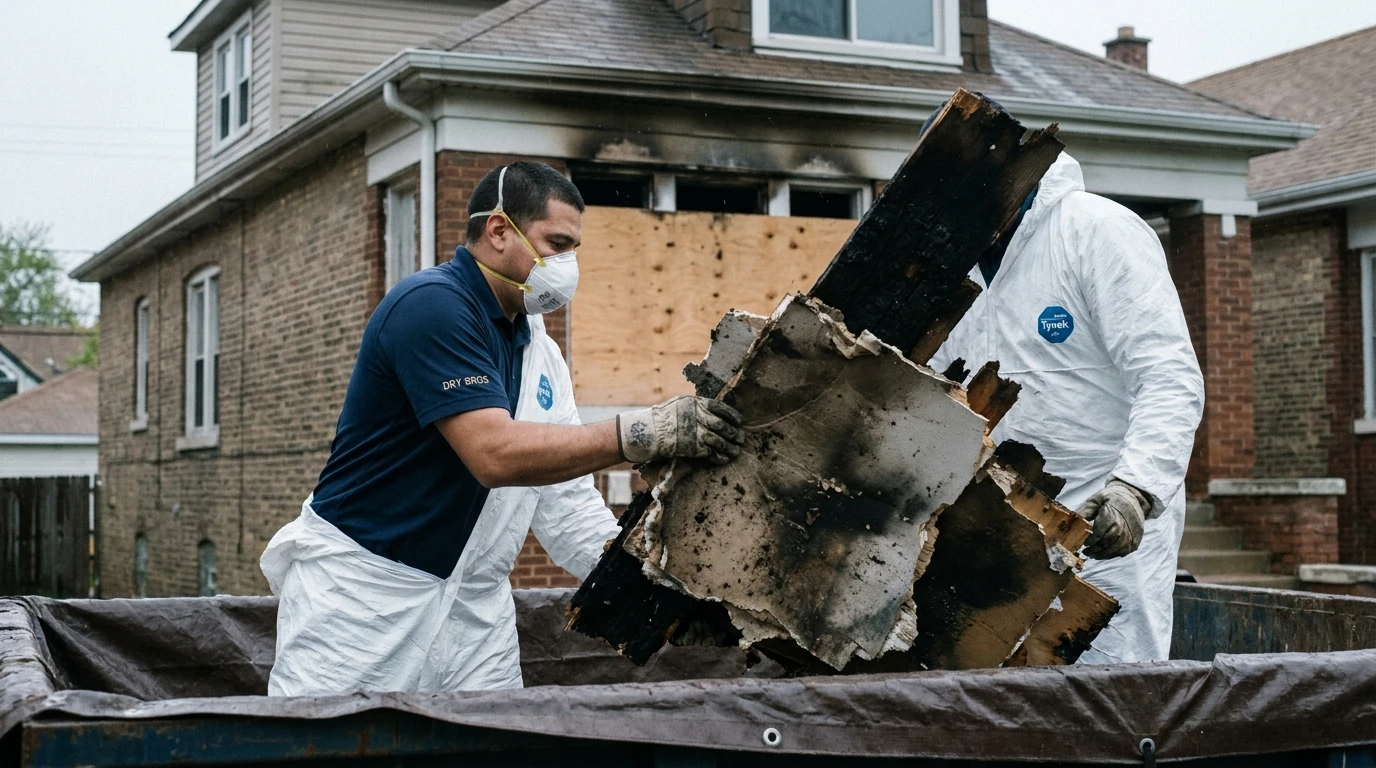
Fire debris removal in Chicago typically costs $500 to $5,000, driven by how much charred material needs to leave the structure and whether any of it requires hazardous-material handling. A single burned room generates a dumpster’s worth of charred drywall, insulation, and cabinetry; a structural total loss can require multiple roll-off containers.
Older Chicago housing stock, particularly bungalows and two-flats built before the 1980s, sometimes contains asbestos in old plaster, floor tile, or pipe insulation, or lead paint under newer layers. If a fire exposes these materials, debris removal shifts from standard haul-out to regulated abatement, which raises the cost and the timeline. A responsible contractor will test before demolition rather than assume.
Will homeowners insurance cover fire damage restoration in Illinois?
Most standard Illinois homeowners policies cover fire damage, including the structure, smoke damage, and damaged personal belongings, minus your deductible, according to the Insurance Information Institute. Coverage typically also includes additional living expenses if the home is temporarily uninhabitable.
What gets disputed is scope, not whether the claim is covered at all. Adjusters sometimes underestimate how far smoke traveled, especially in a two-flat where odor crossed into a unit that wasn’t near the fire. A detailed, itemized scope of work, with moisture and soot readings documented room by room, is what supports a full and accurate claim payout. If you have questions about how a specific policy responds, the Illinois Department of Insurance publishes consumer guidance on filing and disputing claims.
What does the fire damage restoration process actually involve?
The process runs in a predictable order: stabilize, assess, clean, and rebuild. Skipping steps or doing them out of order is what drives costs up later.
- Emergency board-up and tarping secures broken windows, damaged doors, and roof openings the same day to stop weather and theft exposure.
- Assessment and scope documents the class of fire, soot type, and structural damage, following the IICRC’s fire and smoke restoration standard, and becomes the basis for your insurance claim.
- Water extraction, when firefighting efforts left standing water, happens before soot cleanup starts.
- Soot and smoke cleanup removes residue from salvageable surfaces and contents, followed by odor treatment.
- Contents restoration cleans and stores salvageable belongings off-site while reconstruction happens.
- Demolition and rebuild, permitted through the City of Chicago where structural, brings the home back to pre-loss condition.
Our fire damage restoration process guide walks through each phase in more detail if you want the full picture before an adjuster walks your property.
If you’re standing in a smoke-damaged kitchen right now trying to figure out what this is going to cost, the fastest path to a real number is a documented, written scope, not a guess over the phone. Dry Bros can walk the property, document the damage for your insurance file, and give you a line-item estimate before anything gets torn out.
About Dry Bros
Dry Bros is a licensed and insured restoration company serving Chicago and the surrounding suburbs, including Naperville, Oak Park, Evanston, and Cicero, with 24/7 emergency response. This guide was prepared by the Dry Bros team, led by Amin Mashouf, who works directly with Chicago homeowners on fire, smoke, and water damage claims and restoration scopes across the two-flats, bungalows, and single-family homes that make up the city’s housing stock.
Need help now? Call Dry Bros at (877) 379-2767.